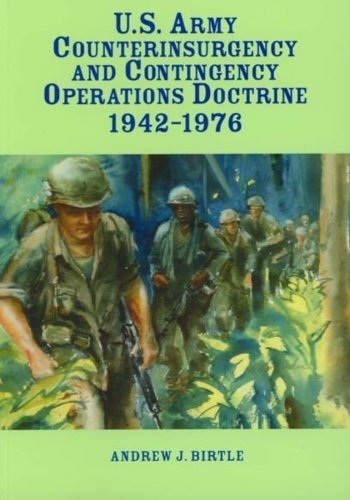
U.S. Army Counterinsurgency and Contingency Operations Doctrine 1942-1976
0
0
As an Amazon Associate and affiliate partner, Menrva Books earns from qualifying purchases. Learn more
Author Description
U.S. Army Counterinsurgency and Contingency Operations Doctrine, 1942-1976, is the second installment in the two-volume study on the U.S. Army's experience in "small war" situations and the development of low-intensity conflict doctrine. As the U.S. government wrestles with tough questions on how to bring peace and stability to countries torn by internal strife, Andrew J. Birtle provides context for these concerns by describing how the United States attempted to suppress insurgencies and build nations during the Cold War. Employing a range of primary and secondary sources, Birtle explains how the Army in the 1950s and 1960s developed a dual strategy that combined military measures with political and socioeconomic reforms. On the military side, he states, doctrine advocated aggressive offensive operations, elaborate intelligence networks, and extensive security measures to drive the guerrillas away from inhabited areas and to secure the population from rebel influence and intimidation. On the civil side, Birtle continues, doctrine called for the implementation of measures to restore the norms of social and economic life; to establish efficient and popular government; and to redress, when possible, the causes of unrest. Birtle uses case studies of counterinsurgency wars in Greece, Korea, the Philippines, Latin America, and Vietnam to explore the strengths and weaknesses of the nation's approach to counterinsurgency. Although the United States' counterinsurgency record was mixed, Birtle shows that the precepts underpinning U.S. doctrine have remained surprisingly constant over the years. By furnishing an in-depth look at how the Army performed its counterinsurgency and nation-building responsibilities during a previous era of global instability, Birtle sheds some needed light on the work that must be done today and tomorrow.
Menrva's Summary
THE THESIS
This book examines the evolution of U.S. Army doctrine for counterinsurgency and contingency operations between 1942 and 1976. Andrew J. Birtle analyzes the development of low-intensity conflict strategies, detailing how the Army combined military offensives, intelligence gathering, and security measures with political and socioeconomic reforms. The work draws on primary and secondary sources to explore case studies from Greece, Korea, the Philippines, Latin America, and Vietnam. Birtle demonstrates the enduring principles within U.S. counterinsurgency doctrine despite a mixed historical record.
THE SCOPE MAP
- The development of U.S. Army doctrine for "small war" situations and low-intensity conflict from 1942 to 1976.
- An analysis of the dual strategy combining military measures with political and socioeconomic reforms.
- Details on aggressive offensive operations, intelligence networks, and security measures advocated in doctrine.
- Examination of civil-side reforms aimed at restoring social and economic life and addressing causes of unrest.
- Case studies of counterinsurgency wars in Greece, Korea, the Philippines, Latin America, and Vietnam.
- An exploration of the strengths and weaknesses of the U.S. approach to counterinsurgency and nation-building during the Cold War.
THE AUTHORITY PERSPECTIVE
The book is presented as a scholarly examination of historical U.S. military doctrine, drawing on extensive research and case studies. Its value lies in providing context for contemporary challenges in peace and stability operations by detailing past attempts to suppress insurgencies and build nations. The author's analysis highlights the surprising constancy of core precepts within U.S. counterinsurgency doctrine over several decades. This work offers a needed perspective on the complexities of military and civil engagement in unstable regions.
Page Count:
586
Publication Date:
2015-02-27
Publisher:
CreateSpace Independent Publishing Platform
ISBN-10:
1508650470
ISBN-13:
9781508650478
History
Non-Fiction
Sociology
Military History
Community Tags
Similar Books