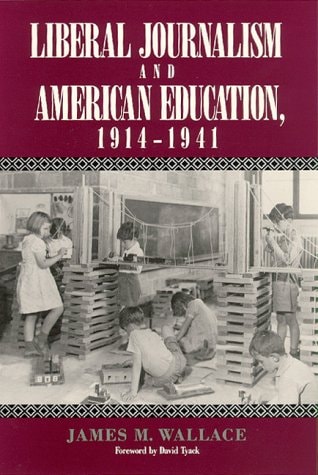
Liberal Journalism and American Education: 1914-1941
0
0
As an Amazon Associate and affiliate partner, Menrva Books earns from qualifying purchases. Learn more
Author Description
This book traces and analyzes the relationships between educational developments and liberal journalism, as represented by The Nation and The New Republic, from 1914 to 1941. James Wallace provides new perspectives on journalists, activists, and educators like Randolph Bourne, John Dewey, Herbert Croly, Walter Lippmann, Oswald Villard, and Agnes de Lima.The first part of the book, covering the 1914-1921 period, interprets the responses of the journals to the "cult of efficiency" in schools, to academic freedom struggles, and to the role of education in the broad reform movement. The second section, on the 1920s, explores the journals' support of the worker education movement and of progressive schools, and critiques the charge of anti-intellectualism that has been leveled at progressive education and particularly at John Dewey. In his analysis of the 1930s, Wallace notes that liberals were now operating in a friendlier political climate, and that this changed their educational interests. Wallace explains the journals' role in the struggle between liberals and radicals for control of the American Federation of Teachers, interprets their treatment of "the revolt of youth," and analyzes their responses to New Deal programs for young people. These chapters place events in the context of the journals' support for the Popular Front with the Communists. In the final section, Wallace analyzes the role of journalism in educational reform and states the need for continued criticism of the kind provided by The Nation and The New Republic.
Menrva's Summary
THE THESIS
This book investigates the intricate connections between the evolving landscape of liberal journalism and the development of American education between 1914 and 1941. James Buchanan Wallace examines the influential roles of publications like The Nation and The New Republic, offering fresh insights into key figures such as Randolph Bourne, John Dewey, and Walter Lippmann. The analysis is structured chronologically, exploring the journals' engagement with educational reform movements, debates on academic freedom, and responses to significant political and social shifts like the Progressive Era, the Roaring Twenties, and the New Deal era.
THE SCOPE MAP
- Analysis of liberal journalism's response to the "cult of efficiency" in schools (1914-1921).
- Examination of academic freedom struggles and education's role in broader reform movements.
- Exploration of support for the worker education movement and progressive schools in the 1920s.
- Critique of the anti-intellectualism charges leveled against progressive education and John Dewey.
- Analysis of educational interests in a friendlier political climate during the 1930s.
- Interpretation of the struggle for control of the American Federation of Teachers.
- Examination of responses to the "revolt of youth" and New Deal programs for young people.
- Discussion of journalism's role in educational reform and the need for continued critical analysis.
THE AUTHORITY PERSPECTIVE
This scholarly work is recognized for its detailed historical analysis of the intersection between liberal journalism and American education during a pivotal period. Wallace's research provides a nuanced understanding of the intellectual currents and debates that shaped educational policy and practice, drawing on primary sources from influential publications. The book is likely to be of significant interest to scholars of American history, journalism, and education, offering a comprehensive overview of the era's key figures and movements.
Page Count:
237
Publication Date:
1991-07-01
Publisher:
Rutgers University Press
ISBN-10:
0813516633
ISBN-13:
9780813516639
Non-Fiction
History
New Deal
Education
American History
Journalism
Community Tags
Similar Books














