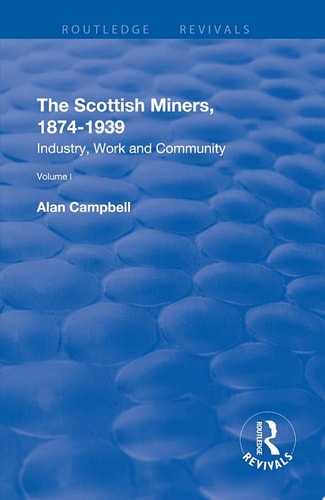
The Scottish Miners, 1874-1939
0
0
As an Amazon Associate and affiliate partner, Menrva Books earns from qualifying purchases. Learn more
Author Description
The Scottish coalfields were among the first areas in Britain to develop socialist politics from the 1880s onwards, although widespread electoral support for the Labour Party was not established until after the First World War. Sections of the Scots miners were also unusual in their support for communism. A breakaway 'Red' union was established in 1929 and two out of the three Communist MPs elected in Britain during the interwar period represented seats in the Scottish coalfields. Strikes were also much more frequent than in any of the English mining areas. But such political radicalism and industrial militancy were far from uniform, either between or within the principal Scots mining regions. This diversity provides the ideal arena in which to analyse the complex and intellectually contested relationships between political and industrial behaviour and class, ethnicity and gender.These volumes develop a new and multi-facetted approach to labour history by studying the interplay between the economic, social and political spheres at the local, regional and national levels for an important group of workers - by the 1920s, miners were the largest single occupational group in Scotland. The books therefore represent not just the study of one group of workers and their families but also make an important and novel contribution to the social history of modern Scotland.
Menrva's Summary
THE THESIS
This book investigates the complex and often contradictory relationships between political behavior, industrial militancy, and the social fabric of class, ethnicity, and gender within the Scottish coalfields from 1874 to 1939. Alan Campbell, a recognized historian of labor and Scottish history, utilizes a multi-faceted approach to analyze the interplay of economic, social, and political spheres at local, regional, and national levels. The study focuses on miners, who by the 1920s constituted the largest occupational group in Scotland, offering a novel contribution to the social history of modern Scotland by examining their lives and struggles.
THE SCOPE MAP
- The development of socialist politics in the Scottish coalfields from the 1880s.
- The rise of widespread electoral support for the Labour Party post-World War I.
- Sections of miners' support for communism and the establishment of a 'Red' union in 1929.
- The representation of Scottish coalfield seats by Communist MPs during the interwar period.
- Analysis of the frequency and nature of strikes in Scottish mining areas compared to English counterparts.
- An examination of the diversity of political radicalism and industrial militancy across different regions.
- The interplay between economic, social, and political spheres at various levels of governance.
THE AUTHORITY PERSPECTIVE
This work is recognized for its detailed examination of a pivotal period in Scottish labor history, offering a nuanced understanding of the factors shaping political and industrial behavior among miners. The multi-faceted approach, considering class, ethnicity, and gender, provides a comprehensive social history of modern Scotland. Its focus on local, regional, and national interactions makes it a significant contribution to the field of labor studies.
Page Count:
433
Publication Date:
2000-01-01
Publisher:
Ashgate
ISBN-10:
0754601935
ISBN-13:
9780754601937
Non-Fiction
History
Social History
Labor history
Scottish History
Community Tags
Similar Books