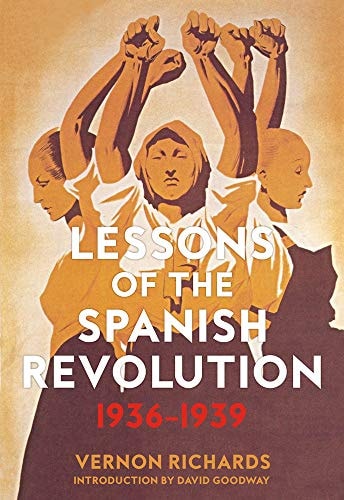
Lessons of the Spanish Revolution 1936-1939
0
0
As an Amazon Associate and affiliate partner, Menrva Books earns from qualifying purchases. Learn more
Author Description
Lessons of the Spanish Revolution examines the many ways in which Spain's revolutionary movement contributed to its own defeat. Was it too weak to carry through the revolution? To what extent was the purchase of arms and raw materials from outside sources dependent upon the appearance of a constitutional government inside Republican Spain? What chances had an improvised army of guerrillas against a trained fighting force? These were some of the practical problems facing the revolutionary movement and its leaders. But in seeking to solve these problems, the anarchists and revolutionary syndicalists were also confronted with other fundamental questions. Could they collaborate with political parties and reformist unions? Given the circumstances, was one form of government to be supported against another? Should the revolutionary impetus of the first days of resistance be halted in the interests of the armed struggle against Franco or be allowed to develop as far as the workers were prepared to take it? Was the situation such that the social revolution could triumph and, if not, what was to be the role of the revolutionary workers? Originally written as a series of weekly articles in the 1950s and expanded, republished, and translated into many languages over the years, Vernon Richards's analysis remains essential reading for all those interested in revolutionary praxis.
Menrva's Summary
THE THESIS
This book examines the critical strategic and political decisions made by the Spanish revolutionary movement during the Spanish Civil War, analyzing how these choices contributed to their ultimate defeat. Vernon Richards, a participant and observer of the events, addresses fundamental questions regarding the movement's internal weaknesses, its reliance on external resources, and the challenges of confronting a trained military force with an improvised army. The work delves into the complex dilemmas faced by anarchists and revolutionary syndicalists, including the viability of collaborating with political parties and reformist unions, the choice between supporting one form of government over another, and the critical decision of whether to prioritize the armed struggle against Franco over the development of the social revolution. Originally published in the 1950s, this analysis remains a key text for understanding revolutionary strategy and its practical application.
THE SCOPE MAP
- An examination of the internal factors contributing to the defeat of the Spanish Revolution.
- Analysis of the challenges posed by external resource acquisition and the role of a constitutional government.
- A discussion on the effectiveness of improvised guerrilla forces against trained armies.
- Exploration of the dilemmas surrounding collaboration with political parties and reformist unions.
- Consideration of whether to halt or advance the social revolution in favor of the armed struggle.
- An assessment of the conditions necessary for a social revolution's triumph and the role of revolutionary workers.
THE AUTHORITY PERSPECTIVE
Vernon Richards's analysis, originally presented as a series of articles in the 1950s and subsequently expanded and translated, is recognized as essential reading for those interested in revolutionary praxis. The book directly confronts the complex strategic and political questions that faced the Spanish revolutionary movement, offering a critical examination of the choices that led to its defeat. Its enduring relevance lies in its detailed exploration of the practical problems and fundamental dilemmas encountered by anarchists and revolutionary syndicalists during the Spanish Civil War, making it a valuable resource for understanding the intricacies of revolutionary movements.
Page Count:
286
Publication Date:
2019-01-01
Publisher:
PM Press
ISBN-10:
1629636479
ISBN-13:
9781629636474
Non-Fiction
History
Politics
Social History
Community Tags
Similar Books