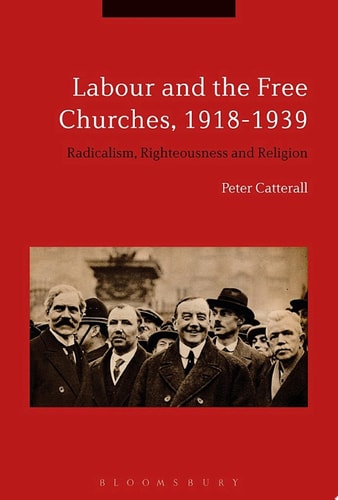
Labour and the Free Churches, 1918-1939
0
0
As an Amazon Associate and affiliate partner, Menrva Books earns from qualifying purchases. Learn more
Author Description
Did the Labour Party, in Morgan Phillips' famous phrase, owe 'more to Methodism than Marx'? Were the founding fathers of the party nurtured in the chapels of Nonconformity and shaped by their emphases on liberty, conscience and the value of every human being in the eyes of God? How did the Free Churches, traditionally allied to the Liberal Party, react to the growing importance of the Labour Party between the wars? This book addresses these questions at a range of levels: including organisation; rhetoric; policies and ideals; and electoral politics. It is shown that the distinctive religious setting in which Labour emerged indeed helps to explain the differences between it and more Marxist counterparts on the Continent, and that this setting continued to influence Labour approaches towards welfare, nationalisation and industrial relations between the wars. In the process Labour also adopted some of the righteousness of tone of the Free Churches. This setting was, however, changing. Dropping their traditional suspicion of the State, Nonconformists instead increasingly invested it with religious values, helping to turn it through its growing welfare functions into the provider of practical Christianity. This nationalisation of religion continues to shape British attitudes to the welfare state as well as imposing narrowly utilitarian and material tests of relevance upon the churches and other social institutions. The elevation of the State was not, however, intended as an end in itself. What mattered were the social and individual outcomes. Socialism, for those Free Churchmen and women who helped to shape Labour in the early twentieth century, was about improving society as much as systems.
Menrva's Summary
THE THESIS
This book investigates the profound influence of Free Church Nonconformity on the development and ideology of the British Labour Party between 1918 and 1939. It examines the extent to which Labour's foundational principles, such as liberty, conscience, and the inherent value of individuals, were shaped by the religious ethos of the chapels, contrasting this with more Marxist-influenced parties on the continent. The study explores how this religious background informed Labour's policies on welfare, nationalization, and industrial relations, and how Nonconformists increasingly viewed the State as a vehicle for practical Christianity, a perspective that continues to shape attitudes towards the welfare state.
THE SCOPE MAP
- Analysis of the organizational, rhetorical, and policy connections between the Labour Party and Free Churches.
- Exploration of the ideological underpinnings of Labour's approach to welfare, nationalization, and industrial relations, as influenced by Nonconformist values.
- Examination of the shift in Free Church attitudes towards the State, moving from suspicion to seeing it as a provider of religious and social values.
- Discussion of how the nationalization of religion through the State impacts contemporary attitudes towards welfare institutions.
- Assessment of the electoral politics and the evolving relationship between the Labour Party and the Liberal Party's traditional Nonconformist base.
- Consideration of how socialism was understood by Free Church adherents as a means to improve both society and individual lives.
THE AUTHORITY PERSPECTIVE
This book offers a detailed historical analysis of the relationship between the Labour Party and the Free Churches in interwar Britain. It argues that the distinctive religious setting of Labour's emergence significantly differentiated it from continental socialist movements and continued to shape its domestic policies. The study highlights how Nonconformists increasingly saw the State as a tool for enacting Christian values, a perspective that has had lasting implications for the British welfare state. The work is grounded in extensive research, providing a nuanced understanding of the ideological and political currents that defined this crucial period.
Page Count:
336
Publication Date:
2016-10-06
Publisher:
Bloomsbury UK
ISBN-10:
144112599X
ISBN-13:
9781441125996
Politics
Non-Fiction
History
Religion
Community Tags
Similar Books














