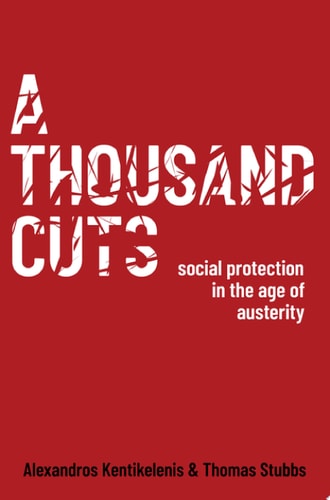
A Thousand Cuts: Social Protection in the Age of Austerity
0
0
As an Amazon Associate and affiliate partner, Menrva Books earns from qualifying purchases. Learn more
Author Description
The dominant policy response to economic crises over the past four decades has been the introduction of austerity--a mix of budget cuts and reforms to downsize the role of the state. The International Monetary Fund (IMF) has been the world's lender of last resort and leading advocate of austerity, and has been consistently chastised by policymakers and civil society for the consequences of its economic policy reforms on social protection. Critics of the IMF have identified so-called structural adjustment programs as a key cause of global increases in poverty, widespread disease, and unemployment. In the face of such criticisms, the IMF has advanced a narrative of wholesale reform to its practices.In A Thousand Cuts, Alexandros Kentikelenis and Thomas Stubbs provide a systematic and comprehensive analysis of IMF policies around the world. Based on novel data from the IMF archives, Kentikelenis and Stubbs have generated a replicable database of all IMF-mandated reforms from 1980-2019 to examine their effects on social policies and outcomes. They reveal that although the precise content of IMF-mandated austerity has changed considerably over time, the organization continues to place a high burden of reform on countries in crisis. These reforms then decrease the availability of important social services and contribute to rises in income inequality and decline in population health.Kentikelenis and Stubbs argue that in spite of reform rhetoric, the IMF's practices--and the outcomes they produce--have changed very little over the past three decades. As one of the first systematic assessments of the impact of austerity on people's lives around the world, A Thousand Cuts makes an important contribution to the continuing debate regarding the consequences of the IMF and how it might better support social protection.
Menrva's Summary
THE THESIS
This book investigates whether the International Monetary Fund (IMF) has genuinely reformed its austerity-driven policies or if it continues to impose structural adjustments that undermine social protection systems globally. Alexandros Kentikelenis and Thomas Stubbs, both experts in political economy and global health, utilize a comprehensive, original database of IMF-mandated reforms spanning 1980 to 2019. Their research challenges the IMF's public narrative of institutional change by demonstrating that the core mechanisms of austerity remain largely intact and continue to negatively impact public health and income equality.
THE SCOPE MAP
What You Will Find
- A systematic analysis of IMF structural adjustment programs from 1980 to 2019.
- A replicable database of policy reforms mandated by the IMF across diverse global economies.
- Quantitative evidence linking austerity measures to declines in social service availability and population health outcomes.
Scope Limits
- The study focuses primarily on the impact of IMF-mandated reforms rather than the internal political decision-making processes within the IMF itself.
- It does not provide a comprehensive alternative macroeconomic model for crisis management.
THE AUTHORITY PERSPECTIVE
Experts recognize this work as a rigorous empirical challenge to the IMF's institutional narrative regarding its post-crisis policy shifts. Readers frequently note the academic density of the prose, which makes it a valuable resource for researchers and policymakers interested in the intersection of global finance and social welfare.
Page Count:
280
Publication Date:
2023-01-01
Publisher:
Oxford University Press
ISBN-10:
0190637730
ISBN-13:
9780190637736
Economics
Public Policy
International relations
Sociology
Community Tags
Similar Books