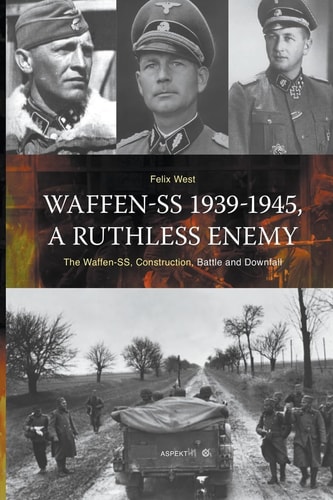
Waffen-SS 1939-1945: A Ruthless Enemy
0
0
As an Amazon Associate and affiliate partner, Menrva Books earns from qualifying purchases. Learn more
Author Description
The Waffen-SS, as fourth 'army branch' of the German army, is still surrounded with a certain mystical fog. Some divisions, mostly from the first levies, have general fame, like Hitler's body guard division, the 'Leibstandarte Adolf Hitler', or the 'Das Reich' division. However, the fact that Waffen-SS grew into a significant force - 38 divisions - during the war, is largely unknown. Yet, due to the expansion, the elite status of the Waff-en-SS lessened. Leveled by its large numbers and the intake of foreigners, the Waffen-SS eventually fell in the streets of Bu-dapest, Berlin, Vienna and in the misty forests of the Ardennes. This book follows the chronological 'red thread' of the Waffen-SS from elite to mass army. It became clear that Hitler increasingly put more trust in his political soldiers. At the source of this was a deep disturst Hitler harboured for the Prussian nobility in the 'Wehrmacht'. After the Von Stauffenberg-attack in the summer of 1944, he leaned on the Waffen-SS more than ever during impor-tant battles. This was a continuation of the politics already de-ployed during the summer battle around Koersk in 1943. After Stalingrad, where the army held the power, the Waffen-SS got a central position. At Koersk, Tarnopol, Kowel, Normandy, the Ar-dennes, Budapest, Vienna, Arnswalde and Berlin, the Waffen-SS played an important role. Still, even they could not turn the tide. Hitler became frustrated and threatened with disciplinary meas-ures against the Waffen-SS. 'They cannot give more than their lives', commented the Reichsführer-SS drily. Under the motto 'un-sere Ehre heißt Treue', the Waffen-SS eventually fell.
Menrva's Summary
THE THESIS
This book investigates the evolution of the Waffen-SS from an elite guard unit into a significant, albeit less exclusive, military force during World War II, exploring Hitler's increasing reliance on them due to his distrust of the traditional Wehrmacht. Perry Pierik, an author with a focus on military history, examines the Waffen-SS's expansion from its early days to its eventual role in major battles across Europe. The book traces the shift from an elite status to a mass army, influenced by its growing numbers and the integration of foreign volunteers. It highlights key engagements and the Waffen-SS's critical, though ultimately unsuccessful, role in attempting to alter the war's outcome.
THE SCOPE MAP
- The chronological development of the Waffen-SS from 1939 to 1945.
- The expansion of the Waffen-SS into 38 divisions and the subsequent dilution of its elite status.
- Hitler's political motivations for favoring the Waffen-SS over the Prussian nobility in the Wehrmacht.
- The Waffen-SS's significant involvement in major battles including Kursk, Tarnopol, Kowel, Normandy, the Ardennes, Budapest, Vienna, Arnswalde, and Berlin.
- The Waffen-SS's ultimate fate and their motto 'unsere Ehre heißt Treue'.
THE AUTHORITY PERSPECTIVE
The book appears to offer a detailed chronological account of the Waffen-SS, focusing on its transformation into a mass army and its strategic importance to Hitler. The narrative emphasizes key battles and the political underpinnings of Hitler's trust in this military branch. The author's approach suggests a focus on historical events and military strategy rather than a critical examination of the Waffen-SS's actions or ideology.
Page Count:
234
Publication Date:
2024-04-10
Publisher:
Aspekt Publishers B.V.
ISBN-13:
9798224429073
Non-Fiction
History
Military History
Community Tags
Similar Books