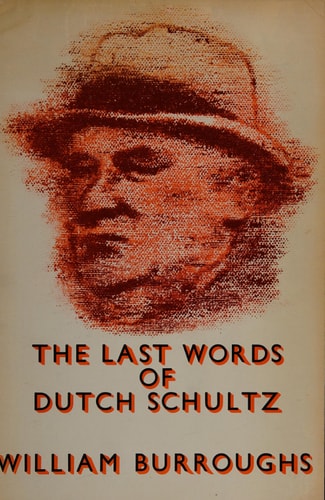
The Last Words of Dutch Schultz
0
0
As an Amazon Associate and affiliate partner, Menrva Books earns from qualifying purchases. Learn more
Author Description
Before he was gunned down in the Palace Chop House in Newark, New Jersey, in October 1935, Arthur Flegenheimer, alias Dutch Schultz, was generally considered New York's Number One racketeer. Taken to a hospital following the gangland shooting, he survived for two days. His room was guarded around the clock, and a police stenographer was stationed at his bedside in the hope of learning who his assailant or assailants were. Instead, what was recorded were Dutch's fevered fantasies, stemming from his childhood and youth, as well as his recent past. Taking these "last words" as his starting point, Burroughs has created his own fantasy of Dutch Schultz, casting his fiction in the form of a film script.
Menrva's Summary
THE PULSE
As the notorious racketeer Dutch Schultz lies dying from gunshot wounds, he descends into a feverish, hallucinatory delirium that becomes the foundation for a surreal cinematic narrative. The protagonist, trapped between the reality of his impending death and the fragmented memories of his criminal life, struggles to maintain a coherent identity as his consciousness fractures. Burroughs employs a non-linear, script-based framework to explore the intersection of power, violence, and the disintegration of the American dream. The narrative forces the reader to navigate a disorienting landscape where the boundaries between historical fact and fever-dream fiction dissolve entirely.
INSIDE THE PAGES
- Structured as a formal film script with scene headings and camera directions
- Utilizes stream-of-consciousness techniques to mirror the protagonist's delirium
- Incorporates historical figures from the 1930s New York underworld
- Features rapid, disjointed shifts in time and location
- Employs dark, satirical humor to critique criminal culture
- Explores themes of paranoia and the corruption of authority
- Uses repetitive, rhythmic prose characteristic of the author's cut-up method
- Blurs the line between the objective reality of the hospital room and the subjective internal monologue
THE COLLECTIVE ECHO
This work is frequently analyzed as a quintessential example of the author's experimental approach to narrative structure and historical myth-making. The text is often noted for its ability to transform a mundane police record into a hallucinatory exploration of the criminal psyche. Readers and critics alike often point to the script format as a deliberate attempt to strip away traditional literary artifice in favor of a more visceral, immediate experience. The book remains a significant point of interest for those examining the intersection of mid-century crime history and avant-garde literature. Its reception is defined by a recognition of the author's unique stylistic voice and his commitment to subverting conventional storytelling methods.
Page Count:
81
Publication Date:
1970-01-01
Publisher:
Cape Goliard P
ISBN-10:
020661764X
ISBN-13:
9780206617646
Crime
Historical
Screenplay
Experimental