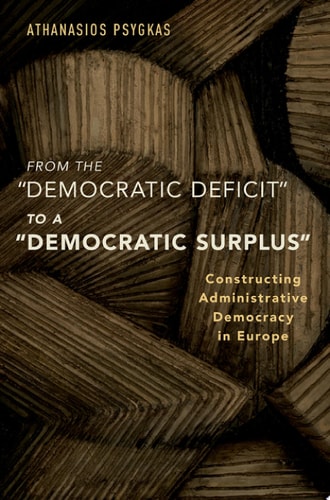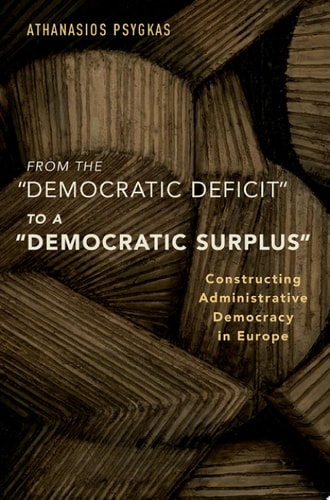
From the "Democratic Deficit" to a "Democratic Surplus": Constructing Administrative Democracy in Europe
0
0
As an Amazon Associate and affiliate partner, Menrva Books earns from qualifying purchases. Learn more
Author Description
Challenging the conventional narrative that the European Union suffers from a "democratic deficit," Athanasios Psygkas argues that EU mandates have enhanced the democratic accountability of national regulatory agencies. This is because EU law has created entry points for stakeholder participation in the operation of national regulators; these avenues for public participation were formerly either not open or not institutionalized to this degree.By focusing on how the EU formally adopted procedural mandates to advance the substantive goal of creating an internal market in electronic communications, Psygkas demonstrates that EU requirements have had significant implications for the nature of administrative governance in the member states. Drawing on theoretical arguments in favor of decentralization traditionally applied to substantive policy-making, this book provides insight into regulatory processes to show how the decentralized EU structure may transform national regulatory authorities into individual loci of experimentation that might in turn develop innovative results. It thus contributes to debates about federalism, governance and public policy, as well as about deliberative and participatory democracy in the United States and Europe.This book informs current understandings of regulatory agency operations and institutional design by drawing on an original dataset of public consultations and interviews with agency officials, industry and consumer group representatives in Paris, Athens, Brussels, and London. The on-the-ground original research provides a strong foundation for the directions the case law could take and small- and larger-scale institutional reforms that balance the goals of democracy, accountability, and efficiency.
Menrva's Summary
THE THESIS
This book investigates whether European Union mandates have created a 'democratic surplus' by enhancing the accountability and participatory capacity of national regulatory agencies. Athanasios Psygkas, a scholar of administrative law and governance, challenges the prevailing 'democratic deficit' narrative by analyzing how EU procedural requirements influence national regulatory frameworks. He argues that by institutionalizing stakeholder participation, EU law transforms national agencies into sites of democratic experimentation and improved governance.
THE SCOPE MAP
What You Will Find
- Analysis of procedural mandates within the electronic communications sector.
- Theoretical framework connecting decentralization to administrative governance.
- Original dataset derived from public consultations and stakeholder interviews.
Scope Limits
- The study focuses primarily on the electronic communications sector rather than all regulatory domains.
- The research is geographically limited to institutional practices in Paris, Athens, Brussels, and London.
THE AUTHORITY PERSPECTIVE
Experts recognize this work as a rigorous contribution to the study of EU administrative law and institutional design. Readers frequently note the academic density of the prose, which provides a detailed empirical foundation for debates regarding federalism and participatory democracy.
Page Count:
376
Publication Date:
2017-11-14
Publisher:
Oxford University Press
ISBN-10:
0190632763
ISBN-13:
9780190632762
Governance
Public Finance
Government relations
Consumer Behavior
Professional Career & Trade
Law
Public Administration
European Union
Decentralization in government
Community Tags
Similar Books