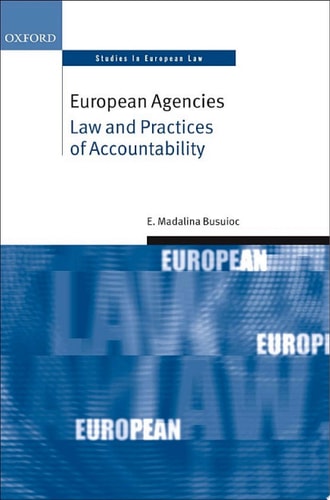
European Agencies: Law and Practices of Accountability
0
0
As an Amazon Associate and affiliate partner, Menrva Books earns from qualifying purchases. Learn more
Author Description
European agencies have been created at a rapid pace in recent years in a multitude of highly pertinent and sensitive fields ranging from pharmaceuticals and aviation safety to chemicals or financial supervision. This agency phenomenon shows no signs of relenting, and the trend in recent years is towards the delegation of ever-broader powers. These bodies, meant to operate at arm's length from political control, have real power and their opinions and decisions can have a direct impact on individuals, regulators, and member states. Given the powers wielded by the agencies, who is responsible for holding these non-majoritarian actors to account? Is the growing concern surrounding agency accountability 'much ado about nothing' or are we faced with the threat of a powerful and unaccountable bureaucracy? These are precisely the questions that this book seeks to answer. It thus addresses one of the most relevant topics in current European governance: the accountability of European agencies. Scholars have increasingly called attention to the risk of placing too much power in the hands of such agencies, which operate at arm's length from traditional controls and cannot easily be held accountable for their actions. Although this is a major issue of concern, systematic empirical research into the topic is lacking. This book addresses empirically whether, and if so on what counts, agency accountability is problematic. It examines how the accountability system of European agencies operates at both the de jure as well as the de facto level, through an examination of legal provisions, relevant case law as well as policy documents and extensive interview material. Reflecting on these findings, the book also offers important theoretical insights for our understanding and study of accountability in a complex regulatory regime such as the EU context. The book follows a multi-disciplinary approach and is at the cutting edge of law and public administration.
Menrva's Summary
THE THESIS
This book investigates the core question of how European agencies, which operate with significant autonomy from traditional political control, can be held accountable for their decisions and actions. Author Madalina Busuioc, an expert in European governance, utilizes a multi-disciplinary framework to evaluate the gap between legal theory and practical implementation. By synthesizing empirical data with legal analysis, the work challenges the assumption that these non-majoritarian actors exist in a vacuum of oversight and provides a structured assessment of the risks associated with delegated power.
THE SCOPE MAP
What You Will Find
- Analysis of the de jure and de facto accountability systems within EU agencies.
- Examination of legal provisions, relevant case law, and policy documentation.
- Empirical findings derived from extensive interview material with stakeholders.
Scope Limits
- The study focuses primarily on the EU regulatory context and does not provide a comparative analysis of non-European administrative agencies.
- The text does not offer prescriptive policy reforms but rather focuses on the diagnostic evaluation of current accountability mechanisms.
THE AUTHORITY PERSPECTIVE
Experts in European law and public administration identify this work as a foundational empirical study on the governance of non-majoritarian bodies. Readers frequently note the academic density of the prose, which is considered highly suitable for scholars and practitioners navigating the complexities of EU regulatory regimes.
Page Count:
325
Publication Date:
2013-01-01
Publisher:
OUP Oxford
ISBN-10:
0191650935
ISBN-13:
9780191650932
Law
Liability Law
European Union
Governance
Professional Career & Trade
Public Administration
Community Tags
Other Editions(3)

Similar Books













Reader Comments
Share Your Thoughts
No comments yet. Be the first to share your thoughts!