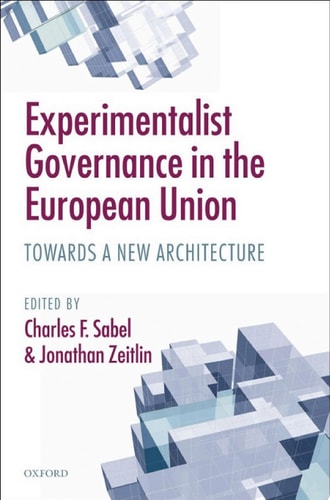
Experimentalist Governance in the European Union: Towards a New Architecture
0
0
As an Amazon Associate and affiliate partner, Menrva Books earns from qualifying purchases. Learn more
Author Description
This book advances a novel interpretation of EU governance. Its central claim is that the EU's regulatory successes within-and increasingly beyond-its borders rest on the emergence of a recursive process of framework rule making and revision by European and national actors across a wide range of policy domains. In this architecture, framework goals and measures for gauging their achievement are established by joint action of the Member States and EU institutions. Lower-level units are given the freedom to advance these ends as they see fit. But in return for this autonomy, they must report regularly on their performance and participate in a peer review in which their results are compared with those of others pursuing different means to the same general ends. The framework goals, performance measures, and decision-making procedures are themselves periodically revised by the actors, including new participants whose views come to be seen as indispensable to full and fair deliberation. The editors' introduction sets out the core features of this experimentalist architecture and contrasts it to conventional interpretations of EU governance, especially the principal-agent conceptions underpinning many contemporary theories of democratic sovereignty and effective, legitimate law making. Subsequent chapters by an interdisciplinary group of European and North American scholars explore the architecture's applicability across a series of key policy domains, including data privacy, financial market regulation, energy, competition, food safety, GMOs, environmental protection, anti-discrimination, fundamental rights, justice and home affairs, and external relations. Their authoritative studies show both how recent developments often take an experimentalist turn but also admit of multiple, contrasting interpretations or leave open the possibility of reversion to more familiar types of governance. The results will be indispensable for all those concerned with the nature of the EU a
Menrva's Summary
THE THESIS
This book investigates whether the European Union's regulatory success is rooted in a recursive process of framework rule-making and revision known as experimentalist governance. Charles F. Sabel and Jonathan Zeitlin, both prominent scholars in political science and law, argue that the EU functions through a system where framework goals are set jointly by Member States and EU institutions, while lower-level units retain autonomy in implementation. This model relies on regular performance reporting and peer review to refine rules, contrasting sharply with traditional principal-agent theories of democratic sovereignty. The authors synthesize contributions from an interdisciplinary group of experts to demonstrate how this architecture operates across diverse policy domains.
THE SCOPE MAP
What You Will Find
- A detailed framework for understanding recursive rule-making and peer review mechanisms.
- Comparative analysis of EU governance versus conventional principal-agent models.
- Case studies covering data privacy, financial regulation, energy, food safety, and environmental protection.
- Theoretical discussions on democratic legitimacy and effective law-making.
Scope Limits
- The text does not provide a comprehensive history of all EU institutions.
- It does not offer a definitive prediction on the future stability of the experimentalist model.
THE AUTHORITY PERSPECTIVE
Experts identify this work as a foundational text for understanding the mechanics of EU regulatory policy. Readers frequently note the academic density of the prose, which is intended for scholars and policy practitioners familiar with institutional theory.
Page Count:
386
Publication Date:
2010-01-01
Publisher:
OUP Oxford
ISBN-10:
0191610186
ISBN-13:
9780191610189
Linguistics
European Union
Governance
Professional Career & Trade
English & College Success
English
Law
Architecture
Public Policy
International relations
Community Tags
Similar Books













Reader Comments
Share Your Thoughts
No comments yet. Be the first to share your thoughts!