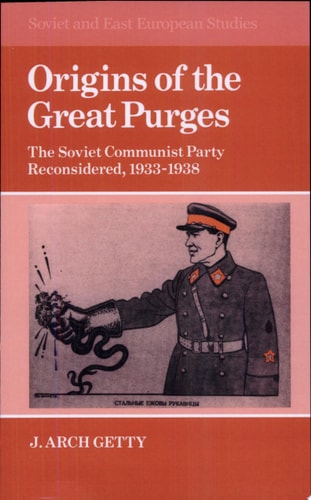
Origins of the Great Purges: The Soviet Communist Party Reconsidered, 1933-1938
0
0
As an Amazon Associate and affiliate partner, Menrva Books earns from qualifying purchases. Learn more
Author Description
This is a study of the structure of the Soviet Communist Party in the 1930s. Based upon archival and published sources, the work describes the events in the Bolshevik Party leading up to the Great Purges of 1937-1938. Professor Getty concludes that the party bureaucracy was chaotic rather than totalitarian, and that local officials had relative autonomy within a considerably fragmented political system. The Moscow leadership, of which Stalin was the most authoritarian actor, reacted to social and political processes as much as instigating them. Because of disputes, confusion, and inefficiency, they often promoted contradictory policies. Avoiding the usual concentration on Stalin's personality, the author puts forward the controversial hypothesis that the Great Purges occurred not as the end product of a careful Stalin plan, but rather as the bloody but ad hoc result of Moscow's incremental attempts to centralise political power.
Menrva's Summary
THE THESIS
This study investigates the structural chaos and fragmented political system of the Soviet Communist Party in the 1930s, challenging totalitarian interpretations of the era. Professor Getty, drawing on archival and published sources, details the events leading to the Great Purges of 1937-1938, arguing that local officials possessed significant autonomy. The Moscow leadership, including Stalin, often reacted to existing social and political dynamics rather than solely dictating them, leading to contradictory policies due to disputes and inefficiency. Getty posits that the purges were not the result of a deliberate Stalinist plan, but rather an ad hoc, violent outcome of Moscow's efforts to centralize power.
THE SCOPE MAP
- Analysis of the Soviet Communist Party's structure and bureaucracy between 1933 and 1938.
- Examination of the events and political climate leading to the Great Purges of 1937-1938.
- Argument for a chaotic, rather than totalitarian, party bureaucracy.
- Exploration of the relative autonomy of local officials within a fragmented political system.
- Assessment of the Moscow leadership's role, including Stalin's, in reacting to and instigating policies.
- Discussion of contradictory policies resulting from disputes, confusion, and inefficiency.
- Controversial hypothesis that the Great Purges were an ad hoc result of centralization attempts, not a pre-planned event.
THE AUTHORITY PERSPECTIVE
This work is regarded as a significant scholarly contribution that re-examines the nature of Soviet power in the 1930s. By focusing on archival evidence, it challenges prevailing notions of a monolithic, totalitarian state, instead presenting a more complex picture of bureaucratic fragmentation and local autonomy. The author's hypothesis regarding the ad hoc nature of the Great Purges has sparked considerable academic debate, offering a nuanced perspective that moves beyond personality-driven explanations of historical events. The book is noted for its rigorous research and its impact on subsequent historical interpretations of the Stalinist era.
Page Count:
276
Publication Date:
1987-01-30
Publisher:
Cambridge University Press
ISBN-10:
0521335701
ISBN-13:
9780521335706
Non-Fiction
Politics
History
Soviet Union
Communism
20th Century
Community Tags
Similar Books