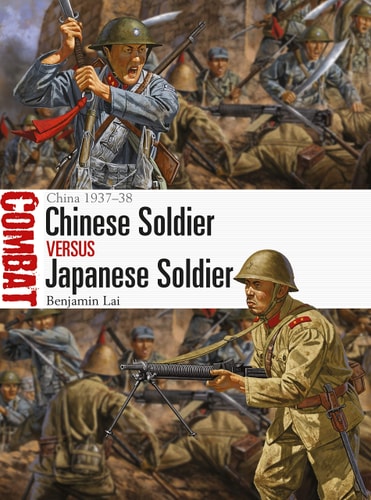
Chinese Soldier vs Japanese Soldier: China 1937–38
0
0
As an Amazon Associate and affiliate partner, Menrva Books earns from qualifying purchases. Learn more
Author Description
In July 1937, the Marco Polo Bridge Incident sparked a bloody conflict between Chinese and Japanese forces that would rage across China and beyond for more than eight years. The two sides' forces brought very different strengths and limitations to the conflict. In 1937 China was divided into factions, each controlled by warlords with independent forces, and there was no unified Chinese army. In order to fight the Japanese Chiang Kai-shek, the nominal leader of Nationalist China, was compelled to do deals with these regional powers. For their part, the Japanese employed ground forces broadly comparable to those fielded by Western powers, including modern artillery and tanks. Featuring specially commissioned artwork and drawing upon an array of sources, this study investigates the origins, training, doctrine, and armament of the Chinese and Japanese forces who fought in the opening stages of the Second Sino-Japanese War.
Menrva's Summary
THE THESIS
The Second Sino-Japanese War erupted in 1937, pitting a fragmented Chinese military against the modern, industrialized forces of Japan. The Chinese army, plagued by internal divisions and warlord control, struggled to present a unified front under Chiang Kai-shek's nominal leadership. In contrast, the Japanese forces were equipped with advanced artillery and tanks, comparable to Western powers of the era. This study examines the distinct origins, training, doctrines, and armaments of the soldiers who fought in the war's initial, brutal phase.
THE SCOPE MAP
- The origins, training, and doctrine of Chinese and Japanese forces in 1937-38.
- Analysis of the differing strengths and limitations of both armies.
- Details on the armament, including modern artillery and tanks used by the Japanese.
- The political landscape of China, including warlord divisions and Chiang Kai-shek's efforts at unification.
- The impact of the Marco Polo Bridge Incident as the spark for the conflict.
- Drawing upon an array of sources and featuring specially commissioned artwork.
THE AUTHORITY PERSPECTIVE
This study offers a detailed examination of the military forces involved in the early stages of the Second Sino-Japanese War. It contrasts the fragmented Chinese army with the more technologically advanced Japanese forces, providing insights into their respective training, doctrines, and equipment. The book is noted for its use of diverse sources and commissioned artwork to illustrate the conflict's opening phase. The analysis focuses on the specific military capabilities and organizational structures that defined the combatants in 1937-38.
Page Count:
80
Publication Date:
2018-10-23
Publisher:
Osprey Publishing
ISBN-10:
1472828208
ISBN-13:
9781472828200
Non-Fiction
History
Asian History
Military History
Community Tags
Similar Books