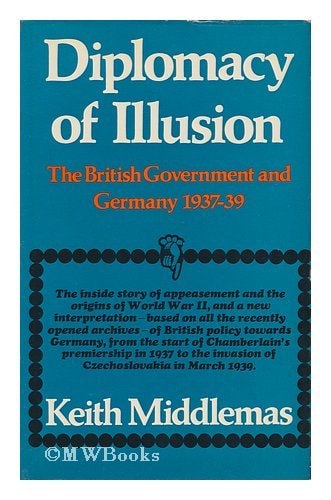
Diplomacy of Illusion: The British Government and Germany, 1937-39
0
0
As an Amazon Associate and affiliate partner, Menrva Books earns from qualifying purchases. Learn more
Author Description
This is the first detailed study of the way in which the British government confronted a resurgent Germany and how it handled the Munich crisis. Taking advantage of recently opened British archives for the year 1939, Mr. Middlemas brings to light whole new aspects of Brutish the influence of Anglo-American and Anglo-French relations; the often faulty ways in which the British Cabinet used the information it received; the pressures of public opinion, the press, and the political parties; the role of the military; and the considerable Cabinet infighting.When Neville Chamberlain became Prime Minister in 1937, he changed Britain's policy towards Germany to a purely defensive one. But no settlement could be reached with Germany or Italy. After the invasion of Austria in March 1938, the British Cabinet feared that Czechoslovakia would be next, thus forcing Britain into the European war on behalf of France. While the Cabinet planned to undo Czechoslovakia and force France to betray her ally, the British armed forces clung to a defensive posture--fitting Britain for the role already sketched out by a separate sphere of influence outside Europe. But by 1938 this was too late.Munich was a bare escape from war. Yet the Chamberlain government failed to learn the lesson and pursued a strategy of appeasement right up to the invasion of Czechoslovakia in March 1939. It also failed to rearm.Mr. Middlemas concludes that Chamberlain's foreign policy was realistic in a narrow sense, in that it fitted Britain's deficiencies. But it included no attempt to educate the public for a more active role and no attempt to rearm--and, in any event, the policy was too late to win back Hitler's earlier offers. It was an approach to the German menace that greatly underestimated British strength, as the war years would show. Mr. Middlemas's extraordinarily complete interpretation of these events makes his book an indispensable source for anyone seriously concerned with the origins of World War II.
Menrva's Summary
THE THESIS
This book investigates the complex and often contradictory foreign policy decisions made by the British government in the years leading up to World War II, specifically focusing on its engagement with a resurgent Germany and its handling of the Munich crisis.
THE SCOPE MAP
- Detailed examination of British government archives from 1937-1939.
- Analysis of Anglo-American and Anglo-French relations during this period.
- Critique of how the British Cabinet utilized intelligence and information.
- Exploration of pressures from public opinion, the press, and political parties.
- Assessment of the role played by the military and internal Cabinet conflicts.
- Discussion of Neville Chamberlain's shift to a defensive foreign policy and its consequences.
- Evaluation of the appeasement strategy and its effectiveness up to the invasion of Czechoslovakia.
THE AUTHORITY PERSPECTIVE
This book is regarded as an indispensable source for understanding the origins of World War II, offering an extraordinarily complete interpretation of the events between 1937 and 1939. The author's use of newly opened British archives provides fresh insights into the British government's approach to Germany and the Munich crisis. It highlights the internal debates, the influence of international relations, and the strategic missteps that characterized British foreign policy during this critical period. The work concludes that while Chamberlain's policy was narrowly realistic given Britain's limitations, it ultimately underestimated the German threat and was too late to alter Hitler's course.
Page Count:
510
Publication Date:
1972-01-01
Publisher:
Weidenfeld and Nicolson
ISBN-10:
0297993909
ISBN-13:
9780297993902
History
Non-Fiction
Politics
Community Tags
Similar Books














