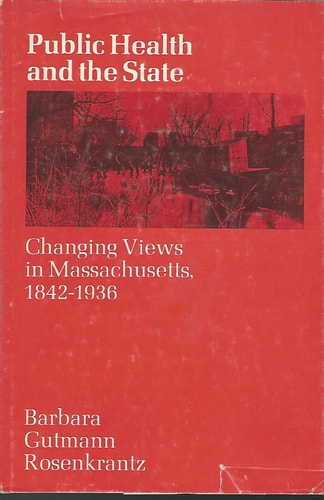
Public Health and the State: Changing Views in Massachusetts. 1842-1936
0
0
As an Amazon Associate and affiliate partner, Menrva Books earns from qualifying purchases. Learn more
Author Description
Public Health and the State constitutes both a fine piece of social history and an ideal model for evaluating our current definition of public health. In this thought-provoking account, Ms. Rosenkrantz perceptively traces the development of the Massachusetts State Board of Health--established in 1869 as the first state institution in the United States responsible for preventing unnecessary mortality and promoting all aspects of public health. This study describes the areas in which state responsibility for deterring disease assumed increased authority after the Civil War. It begins at a time when the definition of health' implied that it could be achieved, supported by the perfectionist belief that a healthy populace--obedient to the laws of nature--guaranteed a sound society. As rapid urban and industrial growth began to sweep the country, however, there was an expressed concern that this expansion threatened the health and morals of the people. During this period, when the etiology of disease was ascribed to a variety of environmental and behavioral factors, the Massachusetts Board developed a comprehensive program of investigation and advice on such diverse issues as housing, water supplies, slaughterhouse conditions, and the use of alcohol. Later, as specific medical prophylaxis and therapy came to characterize public health policy, the relationship between sanitary science and social reform was redefined by both professional standards and public expectation. The State Board depended less and less upon its ability to influence individual conduct. Laboratory scientists, chemists, and physicians, who tended to describe disease in biological terms, directed public health toward science. In view of pressing public health problems posed by such hazards as drug abuse and environmental pollution, Ms. Rosenkrantz warns us that it is as important to identify the origins of the social and scientific assumptions regarding public health as it is to discover the
Menrva's Summary
THE THESIS
This book investigates the evolving definition and implementation of public health policy in Massachusetts from 1842 to 1936. Barbara Gutmann Rosenkrantz, a historian specializing in social history and the history of medicine, examines the establishment and development of the Massachusetts State Board of Health, the first of its kind in the United States. The study traces how societal changes, from rapid urban and industrial growth to advancements in medical science, reshaped the state's role in public health, moving from a focus on societal perfection and environmental factors to specific medical interventions and scientific understanding of disease.
THE SCOPE MAP
- The historical trajectory of public health policy in Massachusetts from the mid-19th to the early 20th century.
- The establishment and evolution of the Massachusetts State Board of Health, founded in 1869.
- Analysis of changing views on the definition of health and the state's responsibility for public well-being.
- Exploration of the impact of urban and industrial growth on public health concerns.
- Examination of the shift from environmental and behavioral factors to specific medical prophylaxis and therapy in public health.
- The redefinition of the relationship between sanitary science and social reform.
- The increasing influence of laboratory scientists, chemists, and physicians in shaping public health policy.
THE AUTHORITY PERSPECTIVE
The book is recognized as a significant contribution to social history and a valuable model for understanding public health. Scholars and readers alike have noted its perceptive tracing of the Massachusetts State Board of Health's development and its insightful analysis of how societal and scientific shifts redefined public health policy. The study is praised for its thorough examination of issues ranging from housing and water supplies to the influence of individual conduct and the biological understanding of disease. It offers a historical perspective that remains relevant for contemporary public health challenges.
Page Count:
271
Publication Date:
1972-01-01
Publisher:
Harvard University Press
ISBN-10:
0674722353
ISBN-13:
9780674722354
History
Non-Fiction
American History
Massachusetts History
Social History
Public Health
Community Tags
Similar Books