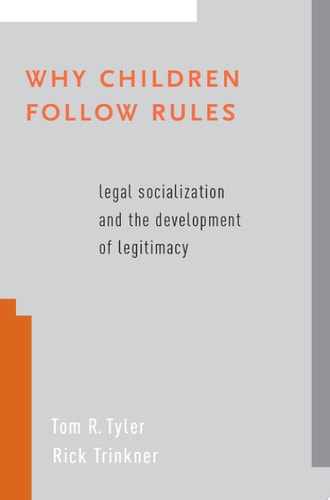
Why Children Follow Rules: Legal Socialization and the Development of Legitimacy
0
0
As an Amazon Associate and affiliate partner, Menrva Books earns from qualifying purchases. Learn more
Author Description
Legal socialization is the process by which children and adolescents acquire their law related values, attitudes, and reasoning capacities. Such values and attitudes, in particular legitimacy, underlie the ability and willingness to consent to laws and defer to legal authorities that make legitimacy based legal systems possible. By age eighteen a person's orientation toward law is largely established, yet legal scholarship has largely ignored this process in favor of studying adults and their relationship to the law. Why Children Follow Rules focuses upon legal socialization outlining what is known about the process across three related, but distinct, contexts: the family, the school, and the juvenile justice system. Throughout, Tom Tyler and Rick Trinkner emphasize the degree to which individuals develop their orientations toward law and legal authority upon values connected to responsibility and obligation as opposed to fear of punishment. They argue that authorities can act in ways that internalize legal values and promote supportive attitudes. In particular, consensual legal authority is linked to three issues: how authorities make decisions, how they treat people, and whether they recognize the boundaries of their authority. When individuals experience authority that is fair, respectful, and aware of the limits of power, they are more likely to consent and follow directives. Despite clear evidence showing the benefits of consensual authority, strong pressures and popular support for the exercise of authority based on dominance and force persist in America's families, schools, and within the juvenile justice system. As the currently low levels of public trust and confidence in the police, the courts, and the law undermine the effectiveness of our legal system, Tom Tyler and Rick Trinkner point to alternative way to foster the popular legitimacy of the law in an era of mistrust.
Menrva's Summary
THE THESIS
This book investigates the developmental processes through which children and adolescents acquire values, attitudes, and reasoning capacities regarding the law and legal authority. Tom R. Tyler and Rick Trinkner, both established scholars in legal psychology, synthesize existing research to argue that legal legitimacy is primarily rooted in internal obligations rather than the fear of punishment. They contend that the development of these values occurs within the family, the school, and the juvenile justice system, and that the behavior of authority figures in these settings is critical to fostering long-term public trust in legal institutions.
THE SCOPE MAP
What You Will Find
- Analysis of legal socialization across three primary contexts: family, school, and juvenile justice.
- A framework for understanding how procedural fairness, respectful treatment, and recognition of authority boundaries influence compliance.
- Examination of the tension between consensual authority and dominance-based enforcement models.
Scope Limits
- The text focuses primarily on the American legal and social context.
- It does not provide a comprehensive history of juvenile law, but rather focuses on the psychological development of legal orientations.
THE AUTHORITY PERSPECTIVE
Experts recognize this work as a significant contribution to the study of legal socialization, noting its clear articulation of how authority figures can foster legitimacy. Readers frequently highlight the academic rigor of the text, which serves as a foundational resource for those studying the intersection of psychology and the legal system.
Page Count:
277
Publication Date:
2017-01-01
Publisher:
Oxford University Press
ISBN-10:
0190644168
ISBN-13:
9780190644161
Psychology
Developmental Psychology
Professional Career & Trade
Education
Criminology
Sociology
Marriage & FamilyFamily Science
Legal Studies
Community Tags
Similar Books