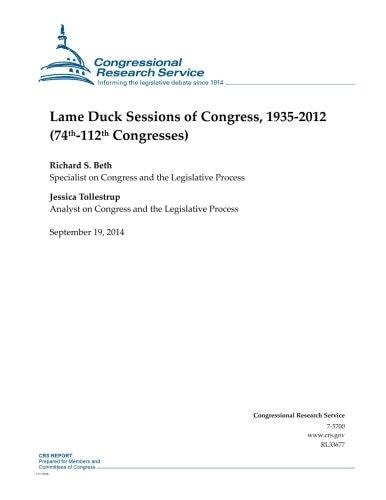
Lame Duck Sessions of Congress, 1935-2012 (74th-112th Congresses)
0
0
As an Amazon Associate and affiliate partner, Menrva Books earns from qualifying purchases. Learn more
Author Description
A "lame duck" session of Congress occurs whenever one Congress meets after its successor is elected, but before the term of the current Congress ends. Under present conditions, any meeting of Congress after election day in November, but before the following January 3, is a lame duck session. Prior to 1933, when the 20th Amendment changed the dates of the congressional term, the last regular session of Congress was always a lame duck session. Today, however, the expression is used not only for a separate session of Congress that convenes after a sine die adjournment, but also for any portion of a regular session that falls after an election.A lame duck session can occur in several ways. (1) Congress has usually provided for its existing session to resume after a recess spanning the election. (In 1954, only the Senate returned in this way, while the House adjourned sine die.) (2) In 1940, 1942, and also most recently in 2008, 2010, and 2012, at least one house continued meeting in intermittent, or pro forma, sessions during the period spanning the election (in these most recent years, the Senate used this means to forestall recess appointments). (3) Congress can reconvene after an election pursuant to contingent authority granted to the leadership in a recess or adjournment resolution (the House followed this course in 1998 and 2008). Two other possibilities have not been realized: (4) Congress could set a statutory date for a new session to convene after the election, then adjourn its existing session sine die. (5) While Congress is in recess or sine die adjournment, the President could call it into extraordinary session at a date after the election.Congress has held 19 lame duck sessions from 1940 through 2012. In these years, election breaks usually have begun by mid-October, and typically lasted between one and two months. Congress has typically reconvened in mid-November and adjourned before Christmas, so that the lame duck session lasted about a month. Yet elect
Menrva's Summary
THE THESIS
The Lame Duck Sessions of Congress examines the historical phenomenon of congressional meetings held after an election but before the end of a term. The book details how these sessions have evolved, particularly after the 20th Amendment changed the dates of the congressional term. It explores the various ways a lame duck session can occur, including Congress resuming after a recess, continuing with pro forma sessions, or reconvening via contingent authority. The work analyzes 19 such sessions held between 1940 and 2012, typically lasting about a month and occurring between mid-November and Christmas.
THE SCOPE MAP
- Definition and historical context of "lame duck" sessions in the U.S. Congress.
- Impact of the 20th Amendment on the timing and nature of lame duck sessions.
- Analysis of different mechanisms by which lame duck sessions can be convened.
- Examination of 19 specific lame duck sessions held between 1940 and 2012.
- Typical duration and timing of lame duck sessions within the election cycle.
- Discussion of the role of recess appointments and contingent authority in session scheduling.
- Coverage of the 74th through 112th Congresses.
THE AUTHORITY PERSPECTIVE
This book provides a detailed historical and procedural analysis of a specific aspect of the U.S. legislative process. The subject matter suggests a focus on the mechanics and historical precedents of "lame duck" sessions, likely appealing to political science students, historians, and those interested in American government. The detailed chronological and procedural breakdown indicates a thorough, fact-based approach to the topic.
Page Count:
34
Publication Date:
2014-09-19
Publisher:
Createspace Independent Publishing Platform
ISBN-10:
1502507994
ISBN-13:
9781502507990
Non-Fiction
History
Politics
Government
Community Tags
Similar Books







Reader Comments
Share Your Thoughts
No comments yet. Be the first to share your thoughts!