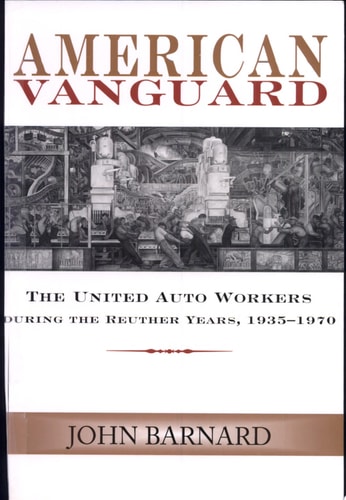
American Vanguard The United Auto Workers During the Reuther Years, 1935-1970
0
0
As an Amazon Associate and affiliate partner, Menrva Books earns from qualifying purchases. Learn more
Author Description
The struggles and victories of the UAW form an important chapter in the story of American democracy. American Vanguard is the first and only history of the union available for both general and academic audiences. In this thorough and engaging narrative, John Barnard not only records the controversial issues tackled by the UAW, but also lends them immediacy through details about the workers and their environments, the leaders and the challenges that they faced outside and inside the organization, and the vision that guided many of these activists. Throughout, Barnard traces the UAW's two-fold goal: to create an industrial democracy in the workplace and to pursue a social-democratic agenda in the interest of the public at large. Part one explores the obstacles to the UAW's organization, including tensions between militant reformers and workers who feared for their jobs; ideological differences; racial and ethnic issues; and public attitudes toward unions. By the outbreak of World War II, however, the union had succeeded in redistributing power on the shop floor in its members' favor. Part two follows the union during Walter P. Reuther's presidency (1946?1970). During this time, pioneering contracts brought a new standard of living and income security to the workers, while an effort was made to move America toward a social democracy?which met with mixed results during the civil rights decade. Throughout, Barnard presents balanced interpretations grounded in evidence, while setting the UAW within the context of the history of the U.S. auto industry and national politics.
Menrva's Summary
THE THESIS
This book chronicles the pivotal role of the United Auto Workers (UAW) union during the transformative Reuther years, from its foundational struggles to its significant impact on American democracy and industry. The narrative details the UAW's dual objectives: establishing industrial democracy within the workplace and advocating for a broader social-democratic agenda. It examines the early obstacles to unionization, including internal divisions and public apprehension, and charts the union's success in redistributing power by World War II. The second part focuses on Walter P. Reuther's presidency, highlighting the negotiation of groundbreaking contracts that secured workers' living standards and income security, alongside efforts to advance social democracy in the United States, which yielded mixed results during the civil rights era.
THE SCOPE MAP
- A comprehensive history of the United Auto Workers (UAW) union from 1935 to 1970.
- Detailed accounts of the UAW's organization, including internal tensions, ideological differences, and racial/ethnic issues.
- Analysis of the union's success in achieving power redistribution on the shop floor by World War II.
- In-depth coverage of Walter P. Reuther's presidency (1946-1970) and his leadership.
- Examination of pioneering contracts that established new standards for worker living conditions and income security.
- Exploration of the UAW's efforts to promote a social-democratic agenda in the wider American context.
- The book is grounded in evidence and places the UAW's history within the broader context of the U.S. auto industry and national politics.
THE AUTHORITY PERSPECTIVE
This comprehensive history of the UAW during the Reuther years is presented as the first and only such account available to both general and academic audiences. The author, John Barnard, is noted for his thorough and engaging narrative, which provides immediate detail through insights into workers, leaders, and their challenges. The book is praised for its balanced interpretations, which are firmly grounded in evidence and situate the union's history within the larger frameworks of the auto industry and national politics. The work aims to illuminate the UAW's significant contributions to American democracy and its pursuit of both industrial and social democracy.
Page Count:
607
Publication Date:
2004-01-01
Publisher:
Wayne State University Press
ISBN-10:
0814332978
ISBN-13:
9780814332979
History
Non-Fiction
Biography
Social History
Labor history
American History
Business History
Community Tags
Similar Books














