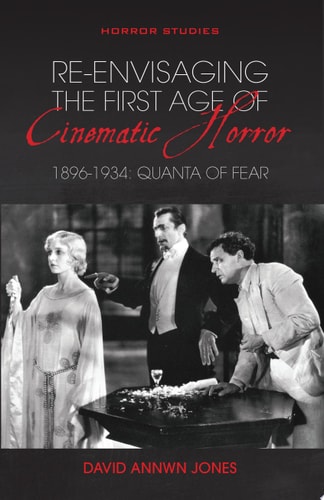
Re-envisaging the First Age of Cinematic Horror, 1896-1934
0
0
As an Amazon Associate and affiliate partner, Menrva Books earns from qualifying purchases. Learn more
Author Description
This is a ground-breaking exploration that runs generally against the critical grain in identifying a burgeoning production of films of fear and horror before the admission of the horror film genre per se. It is a study that reveals and emphasises the formative and innovative power of film, from Georges Méliès’s Le Manoir du Diable (1896) to Edgar G. Ulmer’s superbly reflexive The Black Cat (1934). With its focus on twenty-one key films, and referencing other relevant productions, the present study involves an inclusive and sensitive approach. It reveals an awareness of the heterogeneity of horror production with the discussion spanning the period of the invention of movies, the expansion from single-reelers to longer and continuous productions, and the advent of talkies. Stepping beyond the bounds of Anglo-American studios, in its seven chapters the book involves the work of directors from France, Spain, England, Moravia, Germany, Italy, Denmark, Mexico and the USA, to consider and compare films that have not previously received serious attention.
Menrva's Summary
THE THESIS
This book challenges conventional timelines by arguing for a significant, yet often overlooked, era of horror film production predating the genre's formal recognition. It posits that films of fear and horror were burgeoning from the earliest days of cinema, citing examples from Georges Méliès's "Le Manoir du Diable" (1896) to Edgar G. Ulmer's "The Black Cat" (1934). The study emphasizes the formative and innovative power of early cinema in shaping what would become the horror genre. It adopts an inclusive approach, examining twenty-one key films and referencing others, while acknowledging the heterogeneity of horror production across different eras and regions.
THE SCOPE MAP
- Exploration of early horror films from 1896 to 1934, challenging established genre timelines.
- Focus on twenty-one key films, including Georges Méliès’s Le Manoir du Diable (1896) and Edgar G. Ulmer’s The Black Cat (1934).
- Analysis of the formative and innovative power of early cinema in producing fear and horror.
- Discussion spans the invention of movies, the transition from single-reelers to longer productions, and the advent of sound.
- Inclusion of directors and films from France, Spain, England, Moravia, Germany, Italy, Denmark, Mexico, and the USA.
- Consideration of films that have not previously received significant critical attention.
- An inclusive and sensitive approach to understanding the heterogeneity of horror production.
THE AUTHORITY PERSPECTIVE
This study is positioned as a significant intervention in film history, running against the critical grain to redefine the origins of the horror film genre. By focusing on the period before the genre's formal admission, it highlights the early innovative power of cinema in producing fear. The book's broad geographical scope, encompassing international productions beyond Anglo-American studios, suggests a comprehensive and comparative approach to understanding early horror. Its detailed examination of key films and broader production trends offers a re-envisioned perspective on cinematic history.
Page Count:
272
Publication Date:
2018-11-14
Publisher:
Ingram Publisher Services UK- Academic
ISBN-10:
1786833360
ISBN-13:
9781786833365
History
Art
Horror
Non-Fiction
Cinema
Cinema History
Film Studies
Community Tags
Similar Books