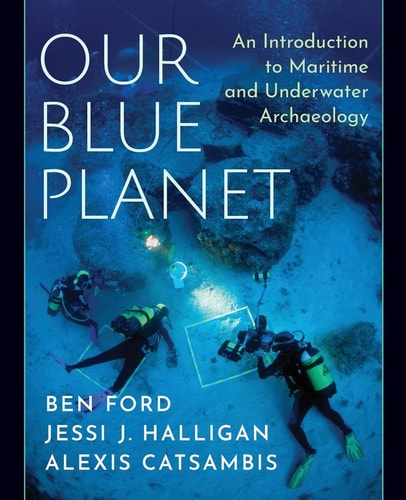
Our Blue Planet: An Introduction to Maritime and Underwater Archaeology
0
0
As an Amazon Associate and affiliate partner, Menrva Books earns from qualifying purchases. Learn more
Author Description
Our Blue Planet provides a comprehensive introduction to the field of maritime and underwater archaeology. Situating the field within the broader study of history and archaeology, this book advocates that an understanding of how our ancestors interacted with rivers, lakes, and oceans is integral to comprehending the human past. Our Blue Planet covers the full breadth of maritime and underwater archaeology, including formerly terrestrial sites drowned by rising sea levels, coastal sites, and a wide variety of wreck sites ranging across the globe and spanning from antiquity to World War II.Beginning with a definition of the field and several chapters dedicated to the methods of finding, recording, and interpreting submerged sites, Our Blue Planet provides an entry point for all readers, whether or not they are familiar with maritime and underwater archaeology or archaeology in general. The book then shifts to a thematic approach with chapters exploring human interactions with the watery world, both along the coasts and by ship. These chapters discuss the relationships between culture, technology, and environment that allowed humans through time to spread across the globe. Because ships were the primary means for humans to interact with large bodies of water, they are the focus of several chapters on the development of shipbuilding technology, the lives of sailors, and the uses of ships in exploration, expansion, and warfare. The book ends with chapters on how and why the non-renewable submerged archaeological record should be managed, so that both current and future generations can learn from the achievements and failures of past societies, as well as on how anyone can become involved in maritime and underwater archaeology. Throughout, the reader benefits from the personal reflections of a number of leading figures in the field.
Menrva's Summary
THE THESIS
How does the study of submerged archaeological sites fundamentally alter our understanding of human history and cultural development? Ben Ford, a specialist in maritime archaeology, presents a comprehensive framework for analyzing human interaction with aquatic environments. By integrating data from drowned terrestrial landscapes, coastal settlements, and shipwrecks, the author argues that maritime activity is not a peripheral interest but a central component of global human history.
THE SCOPE MAP
What You Will Find
- Methodologies for locating, recording, and interpreting submerged archaeological sites
- Analysis of shipbuilding technology from antiquity through World War II
- Case studies on human migration, exploration, and warfare across global waterways
- Discussions on the ethics and management of non-renewable underwater cultural heritage
Scope Limits
- The text focuses primarily on archaeological and historical perspectives rather than deep-sea biological or geological research
- It does not provide exhaustive technical manuals for commercial diving or advanced underwater engineering
THE AUTHORITY PERSPECTIVE
Experts identify this work as a foundational text for students and enthusiasts seeking a structured introduction to the discipline. Readers frequently note the clarity of the prose and the effectiveness of the thematic approach in making complex archaeological concepts accessible to a general audience.
Page Count:
488
Publication Date:
2020-05-14
Publisher:
Oxford University Press
ISBN-10:
0190649933
ISBN-13:
9780190649937
History
Maritime history
Anthropology
Archaeology
Community Tags
Similar Books