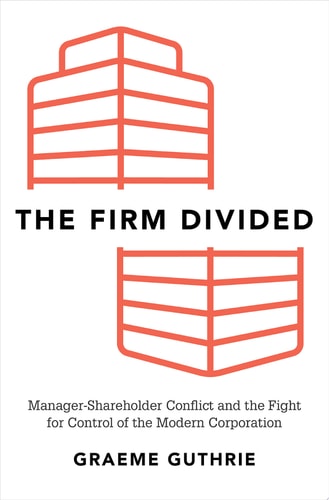
The Firm Divided: Manager-Shareholder Conflict and the Fight for Control of the Modern Corporation
0
0
As an Amazon Associate and affiliate partner, Menrva Books earns from qualifying purchases. Learn more
Author Description
A battle is being fought within corporations. Shareholders want managers to make their shares as valuable as possible, managers want shareholders to leave them alone, and the board of directors is caught in the middle. The Firm Divided shows how strong boards persuade managers to do what's best for shareholders-and why weak boards don't.Graeme Guthrie blends the stories of particular firms and individuals with the insights of scholarly research, enhancing understanding of how seemingly separate events are consequences of the separation of ownership and control, the ultimate cause of manager-shareholder conflict. Boards of directors can affect the outcome of this conflict by monitoring managers, providing incentives for managers to work in shareholders' best interests, delegating monitoring to outside parties, and influencing the effectiveness of the market for corporate control. How directors do this depends on how they weigh their fiduciary duty to shareholders against the close ties that bind them to senior executives.The Firm Divided provides conceptual insight, underpinned by research into corporate governance, into board-manager interactions. It shows how tools that can benefit shareholders when used by strong boards can actually harm shareholders when used by weak boards. Guthrie provides a 360 degree view of firms, exploring the ways in which each player pursues their own goals, with examples from a range of firms in diverse industries.
Menrva's Summary
THE THESIS
This book investigates the structural conflict between managers and shareholders, focusing on how the board of directors acts as the primary mediator in the modern corporation. Graeme Guthrie, an expert in corporate governance, synthesizes academic research with real-world case studies to explain why some boards successfully align management interests with shareholder value while others fail. The text argues that the separation of ownership and control is the root cause of corporate friction, and that the effectiveness of governance tools is entirely dependent on the strength and independence of the board.
THE SCOPE MAP
What You Will Find
- Analysis of the fiduciary duties of directors versus their personal ties to executives
- Examination of incentive structures and monitoring mechanisms
- Case studies from diverse industries illustrating board-manager dynamics
- Exploration of the market for corporate control
Scope Limits
- The text does not provide a comprehensive legal manual for corporate compliance
- It does not focus on day-to-day operational management strategies outside of governance
THE AUTHORITY PERSPECTIVE
Experts recognize this work as a clear, accessible bridge between academic corporate finance theory and practical board-level decision-making. Readers frequently note that the prose remains readable for non-specialists while providing enough analytical depth to satisfy those interested in the mechanics of corporate governance.
Page Count:
351
Publication Date:
2017-01-01
Publisher:
Oxford University Press
ISBN-10:
0190641207
ISBN-13:
9780190641207
Business
Economics
Principles of Management
Finance
Corporate governance
Management
Community Tags
Similar Books