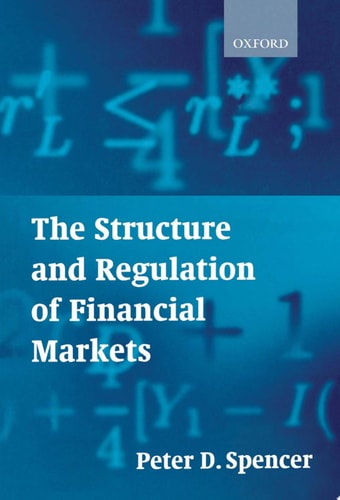
The Structure and Regulation of Financial Markets
0
0
As an Amazon Associate and affiliate partner, Menrva Books earns from qualifying purchases. Learn more
Author Description
Aimed At Advanced Undergraduate And Graduate Students In Economics, Banking, And Finance, This Is A Core Textbook For The Financial Markets, Institutions, And Regulation Option Of Courses In Financial Economics. It Integrates Modern Theories Of Asymmetric Information Into The Analysis Of Financial Institutions, Relating The Theory To Current Developments. The Text Begins With An Analysis Of Adverse Selection In Retail Financial Products Like Life Assurance Before Looking At Open Capital Markets Where Trades And Prices Provide Information. It Then Progresses To The More Complex Areas Of Corporate Governance And Financial Intermediation In Which Information Is Concealed Or Confidential And Moral Hazard And Verification Problems Become Important. These Chapters Study The Various Mechanisms That The Financial Markets Have Developed To Allow Investors To Delegate The Management Of Their Assets To Others. This Analysis Is Used To Show How Regulation Can Reduce The Risk Of Financial Failure And How Legal, Accounting, And Regulatory Mechanisms Can Help Shape A Country's Corporate And Financial Architecture. These Difficult Theoretical Concepts Are Conveyed Through The Careful Use Of Numerical Illustrations And Topical Case Studies. Each Chapter Ends With A Set Of Exercises To Test And Reinforce Students' Comprehension Of The Material. Worked Solutions Are Provided For The Numerical Exercises.
Menrva's Summary
THE THESIS
This text investigates how asymmetric information shapes the structure, function, and regulation of modern financial markets and institutions. Peter D. Spencer, an expert in financial economics, utilizes a framework grounded in modern economic theory to explain how market participants manage risks associated with adverse selection and moral hazard. By integrating theoretical models with practical applications, the author demonstrates how institutional design and regulatory oversight mitigate the potential for financial failure.
THE SCOPE MAP
What You Will Find
- Analysis of adverse selection in retail financial products such as life assurance.
- Examination of corporate governance and financial intermediation mechanisms.
- Numerical illustrations and topical case studies to explain complex theoretical concepts.
- End-of-chapter exercises with provided worked solutions for student assessment.
Scope Limits
- The text focuses primarily on advanced undergraduate and graduate-level economic theory rather than practitioner-level operational manuals.
- It does not provide exhaustive coverage of every global regulatory jurisdiction, focusing instead on general principles of financial architecture.
THE AUTHORITY PERSPECTIVE
Academic reviewers and instructors frequently identify this work as a foundational text for students specializing in financial economics and institutional regulation. The prose is noted for its technical density, requiring a solid grasp of economic theory to fully synthesize the presented concepts.
Page Count:
286
Publication Date:
2000-01-01
Publisher:
Oup Oxford
ISBN-10:
0191586862
ISBN-13:
9780191586866
Economics
Banking
Corporate governance
Finance
textbook