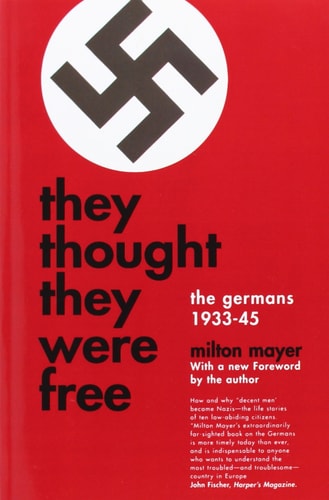
They Thought They Were Free: The Germans, 1933-45
0
0
As an Amazon Associate and affiliate partner, Menrva Books earns from qualifying purchases. Learn more
Author Description
First published in 1955, They Thought They Were Free is an eloquent and provocative examination of the development of fascism in Germany. Mayer’s book is a study of ten Germans and their lives from 1933-45, based on interviews he conducted after the war when he lived in Germany. Mayer had a position as a research professor at the University of Frankfurt and lived in a nearby small Hessian town which he disguised with the name “Kronenberg.” “These ten men were not men of distinction,” Mayer noted, but they had been members of the Nazi Party; Mayer wanted to discover what had made them Nazis. “What happened here was the gradual habituation of the people, little by little, to being governed by surprise; to receiving decisions deliberated in secret; to believing that the situation was so complicated that the government had to act on information which the people could not understand, or so dangerous that, even if the people could not understand it, it could not be released because of national security. And their sense of identification with Hitler, their trust in him, made it easier to widen this gap and reassured those who would otherwise have worried about it.”--from Chapter 13, “But Then It Was Too Late”
Menrva's Summary
THE THESIS
This book investigates the gradual normalization of Nazism in Germany through the personal experiences of ordinary citizens. Milton Sanford Mayer, a research professor at the University of Frankfurt, conducted interviews with ten non-distinguished German men who had been members of the Nazi Party. Living in a disguised town he called "Kronenberg," Mayer sought to understand the psychological and societal factors that led these individuals to embrace the Nazi ideology. The book explores how a populace can become accustomed to secret decision-making, a lack of transparency, and a reliance on a leader, particularly when national security is invoked as a justification.
THE SCOPE MAP
- Analysis of ten individual German lives between 1933 and 1945.
- Interviews conducted by the author after World War II.
- Exploration of the psychological mechanisms of fascism's rise.
- Examination of how ordinary citizens became members of the Nazi Party.
- Discussion of the role of secrecy and perceived complexity in governance.
- The concept of 'habituation' to authoritarian rule.
- The impact of trust in leadership on public compliance.
- A study set in a disguised German town named "Kronenberg".
THE AUTHORITY PERSPECTIVE
Milton Sanford Mayer's "They Thought They Were Free" is recognized as a profound and unsettling examination of how ordinary people become complicit in totalitarian regimes. The book's strength lies in its direct engagement with individuals who lived through the Nazi era, offering a ground-level perspective on the erosion of democratic norms. Critics have noted its enduring relevance for understanding political radicalization and the dangers of unchecked state power. The work is often cited for its insightful analysis of the gradual acceptance of authoritarianism through a process of 'habituation' and misplaced trust.
Page Count:
368
Publication Date:
1966-05-19
Publisher:
University of Chicago Press
ISBN-10:
0226511928
ISBN-13:
9780226511924
Politics
Non-Fiction
History
Sociology
Social Science
Community Tags
Similar Books