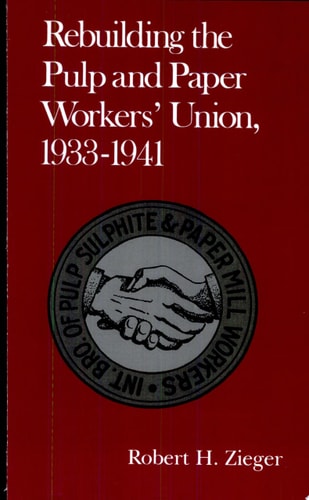
Rebuilding the Pulp and Paper Workers Union 1933-1941
0
0
As an Amazon Associate and affiliate partner, Menrva Books earns from qualifying purchases. Learn more
Author Description
Winner of the Philip Taft Labor History Award (New York State School of Industrial and Labor Relations at Cornell University) This study of the pulp and paper workers' union helps explain the AFL's often limited response to worker militancy in the 1930s as well as the more institutionalized moderation that emerged from the labor upsurge. Zieger sympathetically explains the union's limited goals but steady achievements--i.e., raising wages, narrowing differentials, and organizing blacks, women, and ethnically diverse workers--without resorting to strikes.
Menrva's Summary
THE THESIS
This book investigates the complex process of rebuilding the Pulp and Paper Workers Union between 1933 and 1941. It examines how the union navigated the labor upsurge of the 1930s, explaining the American Federation of Labor's (AFL) cautious approach to worker militancy and the eventual emergence of more institutionalized moderation. The study highlights the union's achievements in raising wages, reducing pay disparities, and integrating diverse workers, including Black individuals, women, and ethnic minorities, all accomplished without resorting to widespread strikes.
THE SCOPE MAP
- The rebuilding and organizational efforts of the Pulp and Paper Workers Union from 1933 to 1941.
- Analysis of the AFL's response to worker militancy during the 1930s.
- The development of institutionalized moderation within the labor movement.
- The union's strategies for raising wages and narrowing pay differentials.
- The inclusion of Black, women, and ethnically diverse workers within the union.
- Case studies of union achievements without the use of strikes.
THE AUTHORITY PERSPECTIVE
Winner of the Philip Taft Labor History Award, this study is recognized for its insightful analysis of labor organizing in the 1930s. It offers a sympathetic yet critical examination of the Pulp and Paper Workers Union's goals and accomplishments. The book provides valuable context for understanding the broader landscape of American labor relations during a pivotal era. Scholars have noted its contribution to explaining the AFL's strategic decisions and the evolution of labor militancy into more structured forms.
Page Count:
256
Publication Date:
2004-11-01
Publisher:
Univ. of Tennessee Press
ISBN-10:
1572333715
ISBN-13:
9781572333710
History
Non-Fiction
Social History
American History
Labor history
Industrial Relations
Community Tags
Similar Books