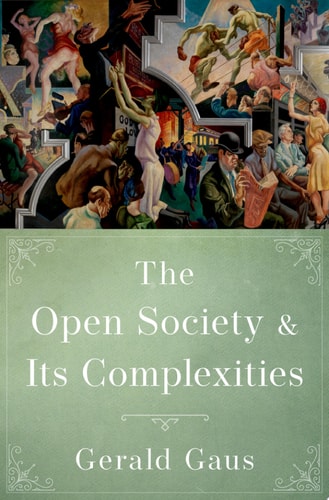
The Open Society and Its Complexities
0
0
As an Amazon Associate and affiliate partner, Menrva Books earns from qualifying purchases. Learn more
Author Description
Preface -- Prolegomenon: Hayek's Three Unsettling Theses -- Beyond Human Nature -- Beyond Moral Justification -- Beyond Human Governance -- Three Enquiries On The Open Society -- The Rise Of A Normative Species -- A Natural History Of Moral Order -- The Starting Point -- The Egalitarian Revolution -- Self-interest, Reciprocity And Altruism -- Internalized, Enforced, Social Rules -- The Other Side Of Morality -- Cultural Evolution -- Part I: The Rise And (partial) Fall Of Inequality -- A Complex Moral Species -- The Diversity And Self-organized Complexity -- Liberalism And The Open Society -- Understanding Diversity -- Autocatalytic Diversity -- Diversity And Complexity -- Too Much Complexity? -- The Morality Of Self-organization -- The Social Contract -- A Self-organization Model -- Moral Diversity In The Open Society -- Part Ii: The Complexities Of Self-governance -- Self-governance -- Macro Control -- Macro Structure -- Strategic Dilemmas And Polycentricity -- Meso-level Goal Pursuit -- Sectoral Policy -- Self-governance From The Bottom-up: Simplifying The Problems Of Governance -- Our Moral Nature And Governance In The Open Society -- Liberal Democracy -- Epilogue -- Appendix A -- Appendix B. Gerald Gaus. Includes Bibliographical References And Index. Electronic Reproduction. Oxford Available Via World Wide Web.
Menrva's Summary
THE THESIS
This work investigates how the open society maintains order and moral cohesion amidst the inherent complexities of human diversity and self-organization. Gerald F. Gaus, a prominent political philosopher, utilizes an interdisciplinary framework combining evolutionary biology, game theory, and classical liberal thought. He argues that the open society is not a product of top-down design but an emergent phenomenon that requires specific institutional structures to manage the challenges of moral and social pluralism.
THE SCOPE MAP
What You Will Find
- An analysis of the evolutionary origins of human moral order and social rules.
- A model of self-organization that explains how diverse individuals coordinate without centralized control.
- A critique of traditional social contract theories in the context of modern complexity.
- Theoretical frameworks for understanding polycentric governance and sectoral policy.
Scope Limits
- The text does not provide a prescriptive policy manual for specific contemporary political crises.
- It does not offer a comprehensive history of liberal political thought, focusing instead on the structural mechanics of the open society.
THE AUTHORITY PERSPECTIVE
Scholars and political theorists frequently cite this work as a significant contribution to the study of spontaneous order and liberal institutionalism. Readers often note the high level of academic density and the rigorous, systematic nature of the author's philosophical arguments.
Page Count:
287
Publication Date:
2021-01-01
Publisher:
Oxford University Press,
ISBN-10:
0190648988
ISBN-13:
9780190648985
Governance
Evolutionary Ethics
Political Philosophy
Social Theory
Liberalism
Social ethics
Community Tags
Similar Books