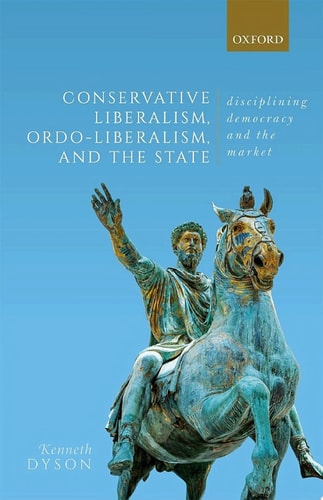
Conservative Liberalism, Ordo-liberalism, and the State: Disciplining Democracy and the Market
0
0
As an Amazon Associate and affiliate partner, Menrva Books earns from qualifying purchases. Learn more
Author Description
This book uses extensive original archival and elite interview research to examine the attempt to rejuvenate liberalism as a means of disciplining democracy and the market through a new rule-based economic and political order. This rebirth took the form of conservative liberalism and, in its most developed form, Ordo-liberalism. It occurred against the historical background of the great transformational crisis of liberalism in the first part of the twentieth century. Conservative liberalism evolved as a cross-national phenomenon. It included such eminent and cultured liberal economists as James Buchanan, Frank Knight, Henry Simons, Ralph Hawtrey, Jacques Rueff, Luigi Einaudi, Walter Eucken, Friedrich Hayek, Alfred Müller-Armack, Wilhelm Röpke, Alexander Rüstow, and Paul van Zeeland, as well as leading lawyers like Louis Brandeis, Franz Böhm, and Maurice Hauriou. Conservative liberals also played a formative role in establishing new international networks, notably the Mont Pèlerin Society. The book investigates the rich intellectual inheritance of this variant of new liberalism from aristocratic liberalism, ethical philosophy, and religious thought. It also locates the social basis of conservative liberalism and Ordo-liberalism in the cultivated bourgeois intelligentsia. The book goes on to examine the attempts to embed this new disciplinary form of liberalism in Britain, France, Germany, Italy, and the United States, and to consider the determinants of its varying significance across space and over time. It concludes by assessing the historical significance and contemporary relevance of conservative liberalism and Ordo-liberalism as liberalism confronts a new transformational crisis at the beginning of the new millennium. Is their promise of disciplining democracy and the market a hollow one?
Menrva's Summary
THE THESIS
This book investigates the historical development and intellectual foundations of conservative liberalism and Ordo-liberalism as mechanisms for regulating democracy and market forces. Kenneth Dyson, a scholar of European politics and political economy, utilizes extensive archival research and elite interviews to trace the evolution of these ideologies. He argues that these movements emerged as a response to the early twentieth-century crisis of liberalism, seeking to establish a rule-based order that would stabilize both economic and political spheres.
THE SCOPE MAP
What You Will Find
- Historical analysis of the Mont Pèlerin Society and its international networks
- Intellectual history tracing roots in aristocratic liberalism, ethical philosophy, and religious thought
- Comparative study of the implementation of Ordo-liberalism in Britain, France, Germany, Italy, and the United States
- Profiles of key figures including Hayek, Eucken, Buchanan, and Röpke
Scope Limits
- The text focuses primarily on the intellectual and political history of the movement rather than purely technical economic modeling
- It does not provide a comprehensive policy guide for contemporary governance
THE AUTHORITY PERSPECTIVE
Scholars recognize this work as a rigorous examination of the intellectual lineage and cross-national application of Ordo-liberalism. Readers frequently note the academic density of the prose, which serves as a detailed reference for students of political economy and modern history.
Page Count:
582
Publication Date:
2021-01-01
Publisher:
OUP Oxford
ISBN-10:
0192596217
ISBN-13:
9780192596215
Economics
History
Political Philosophy
Liberalism
Community Tags
Other Editions(2)
Similar Books

Reader Comments
Share Your Thoughts
No comments yet. Be the first to share your thoughts!