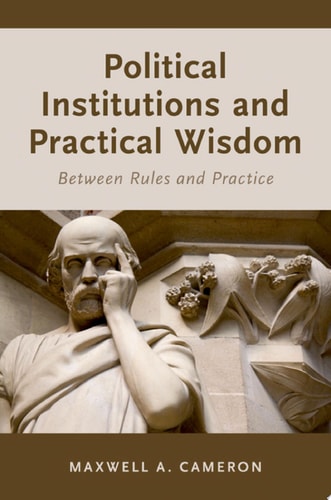
Political Institutions and Practical Wisdom: Between Rules and Practice
0
0
As an Amazon Associate and affiliate partner, Menrva Books earns from qualifying purchases. Learn more
Author Description
Societies create rules that govern our practices. Such rules can only be effective, however, if the intermediaries between rules and practices--institutions--harness the skill, knowledge, and motivation of practitioners. Yet, everywhere institutions seem to be failing. Over-reliance on rules and incentives has not only corrupted the intrinsic motivations that arise from practice, it has also promoted the spread of competitive utility maximizing and thereby discouraged the kind of moral agency necessary for institutions to work well.In Political Institutions and Practical Wisdom, Maxwell Cameron takes this basic insight as his starting point to argue that the rapid spread of the tenets of a neoliberal political-economic philosophy in our era has contributed to the erosion of institutional capacity. The book contributes to an emerging field of social science research grounded in the Aristotelian idea of phronesis, or practical wisdom. Drawing on a wide range of examples, Cameron not only shows how good institutions depend on wise practitioners, he argues that contemporary democratic institutions are being assaulted by excessive partisanship and the hollowing-out of democratic deliberation, by the corrupting effects of money in politics, and by the use of neoliberal techniques of governance that are designed to foster competition rather than the pursuit of common goods.At once a valuable guide to designing effective institutions and a trenchant critique of contemporary institutional failure, Political Institutions and Practical Wisdom promises to reshape our understanding of one of the most basic building blocks of contemporary social and political life.
Menrva's Summary
THE THESIS
How can political institutions function effectively when they rely on rigid rules rather than the cultivation of practical wisdom among their practitioners? Maxwell A. Cameron, a professor of political science, investigates the decline of institutional capacity in the modern era. He argues that the dominance of neoliberal political-economic philosophy has prioritized competitive utility maximization over the Aristotelian concept of phronesis, or practical wisdom, thereby eroding the moral agency required for democratic institutions to succeed.
THE SCOPE MAP
What You Will Find
- An analysis of the intersection between formal rules and human practice
- Application of Aristotelian phronesis to contemporary political science
- Examination of the impact of neoliberal governance techniques on institutional integrity
- Critique of partisanship, money in politics, and the decline of democratic deliberation
Scope Limits
- The text does not provide a comprehensive history of all global political institutions
- It does not offer a technical manual for specific legislative drafting
THE AUTHORITY PERSPECTIVE
Scholars and political theorists identify this work as a significant contribution to the study of institutional design and moral philosophy. Readers frequently note the academic density of the prose, which bridges the gap between classical ethics and modern political science.
Page Count:
232
Publication Date:
2018-07-18
Publisher:
Oxford University Press
ISBN-10:
0190694335
ISBN-13:
9780190694333
Philosophy
Ethics
American Government
Governance
Public Administration
Political Philosophy
Institutional Theory
Institutions Philosophy
Neoliberalism
Social Science
Community Tags
Other Editions(2)
Similar Books