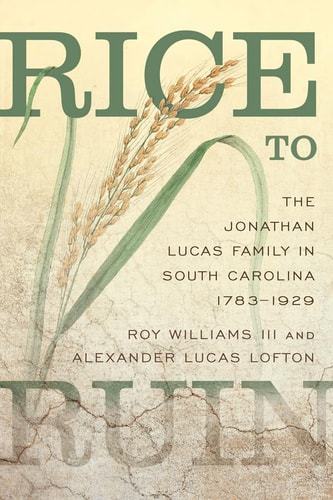
Rice to Ruin: The Jonathan Lucas Family in South Carolina, 1783-1929
0
0
As an Amazon Associate and affiliate partner, Menrva Books earns from qualifying purchases. Learn more
Author Description
The saga of the precipitous rise and ultimate fall of the Jonathan Lucas family's rice-mill dynasty In the 1780s Jonathan Lucas, on a journey from his native England, shipwrecked near the Santee Delta of South Carolina, about forty miles north of Charleston. Lucas, the son of English mill owners and builders, found himself, fortuitously, near vast acres of swamp and marshland devoted to rice cultivation. When the labor-intensive milling process could not keep pace with high crop yields, Lucas was asked by planters to build a machine to speed the process. In 1787 he introduced the first highly successful water-pounding rice mill--creating the foundation of an international rice mill dynasty. In Rice to Ruin, Roy Williams III and Alexander Lucas Lofton recount the saga of the precipitous rise and ultimate fall of that empire. Lucas's invention did for rice, South Carolina's first great agricultural staple, what Eli Whitney did for cotton with his cotton gin. With his sons Jonathan Lucas II and William Lucas, Lucas built rice mills throughout the lowcountry. Eventually the rice kingdom extended to India, Egypt, and Europe after the younger Jonathan Lucas moved to London to be at the center of the international rice trade. Their lives were grand until the American Civil War and its aftermath. The end of slave labor changed the family's fortunes. The capital tied up in slaves evaporated; the plantations and town houses had to be sold off one by one; and the rice fields once described as "the gold mines of South Carolina" often failed or were no longer planted. Disease and debt took its toll on the Lucas clan, and, in the decades that followed, efforts to regain the lost fortune proved futile. In the end the once-glorious Carolina gold rice fields that had brought riches left the family in ruin.
Menrva's Summary
THE THESIS
The Jonathan Lucas family built an international rice-mill dynasty from humble beginnings in South Carolina, only to see it crumble after the Civil War. Jonathan Lucas, an English mill owner's son, was shipwrecked in South Carolina in the 1780s and found himself in a region ripe for agricultural innovation. Recognizing the need for a more efficient milling process, he introduced the first successful water-pounding rice mill in 1787, laying the foundation for a vast empire. This invention revolutionized rice cultivation, South Carolina's primary staple, akin to Eli Whitney's impact on cotton. The family's fortunes soared, extending their reach to India, Egypt, and Europe, but the abolition of slave labor after the Civil War led to the evaporation of capital, the sale of assets, and ultimately, the ruin of the once-glorious Lucas clan.
THE SCOPE MAP
- The origins of Jonathan Lucas in England and his shipwreck in South Carolina.
- The invention and impact of the water-pounding rice mill in the late 18th century.
- The expansion of the Lucas rice empire across continents.
- The profound economic and social consequences of the American Civil War and the end of slave labor on the family's fortunes.
- The subsequent decades of decline, debt, and failed attempts to regain wealth.
- The ultimate fall of the Lucas family from prominence to ruin by 1929.
THE AUTHORITY PERSPECTIVE
This historical account meticulously traces the rise and fall of the Jonathan Lucas family's rice-mill dynasty, detailing their significant impact on South Carolina's economy and the global rice trade. The narrative highlights the pivotal role of Jonathan Lucas's technological innovation and the subsequent expansion of his enterprise. It also critically examines the devastating consequences of the Civil War and the abolition of slavery on the family's wealth and social standing, illustrating how economic shifts and debt ultimately led to their downfall.
Page Count:
427
Publication Date:
2018-01-01
Publisher:
University of South Carolina Press
ISBN-10:
1611178347
ISBN-13:
9781611178340
Non-Fiction
History
Biography
Business History
American South
Community Tags
Similar Books