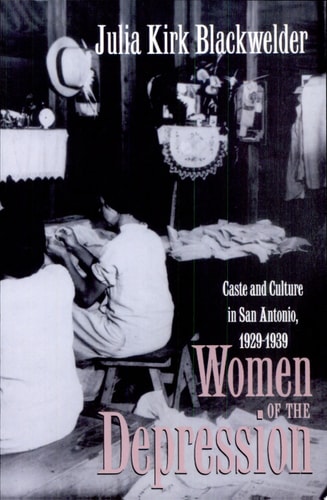
Women of the Depression: Caste and Culture in San Antonio, 1929-1939
0
0
As an Amazon Associate and affiliate partner, Menrva Books earns from qualifying purchases. Learn more
Author Description
Even before the Depression, unemployment, low wages, substandard housing, and poor health plagued many women in what was then one of America's poorest cities--San Antonio. Divided by tradition, prejudice, or law into three distinct communities of Mexican Americans, Anglos, and African Americans, San Antonio women faced hardships based on their personal economic circumstances as well as their identification with a particular racial or ethnic group. Women of the Depression, first published in 1984, presents a unique study of life in a city whose society more nearly reflected divisions by the concept of caste rather than class. Caste was conferred by identification with a particular ethnic or racial group, and it defined nearly every aspect of women's lives. Historian Julia Kirk Blackwelder shows that Depression-era San Antonio, with its majority Mexican American population, its heavy dependence on tourism and light industry, and its domination by an Anglo elite, suffered differently as a whole than other American cities. Loss of migrant agricultural work drove thousands of Mexican Americans into the barrios on the west side of San Antonio, and with the intense repatriation fervor of the 1930s, the fear of deportation inhibited many Mexican Americans from seeking public or private aid. The author combines excerpts from personal letters, diaries, and interviews with government statistics to present a collective view of discrimination and culture and the strength of both in the face of crisis.
Menrva's Summary
THE THESIS
The Great Depression exacerbated existing social and economic inequalities in San Antonio, particularly impacting women across its distinct ethnic and racial communities. Julia Kirk Blackwelder's study examines the lives of Mexican American, Anglo, and African American women in San Antonio during the 1930s, a period when caste, defined by ethnic or racial identity, played a more significant role than class in shaping daily experiences. The book details how the city's unique economic structure, heavily reliant on tourism and light industry and dominated by an Anglo elite, led to distinct hardships compared to other American cities. Blackwelder utilizes personal accounts from letters, diaries, and interviews, alongside government statistics, to illustrate the pervasive discrimination and cultural resilience faced by these women.
THE SCOPE MAP
- Analysis of the caste system in San Antonio and its impact on women's lives.
- Examination of the specific hardships faced by Mexican American, Anglo, and African American women during the Depression.
- Exploration of San Antonio's unique economic conditions and their influence on the Depression's effects.
- Discussion of the impact of lost migrant agricultural work on the Mexican American population.
- Investigation into how repatriation fervor affected Mexican Americans' access to aid.
- Integration of personal narratives from letters, diaries, and interviews.
- Use of government statistics to provide a quantitative perspective.
- Focus on the interplay of discrimination, culture, and resilience.
THE AUTHORITY PERSPECTIVE
This historical study is recognized for its detailed examination of social stratification and the lived experiences of women in a specific American city during a period of national crisis. By focusing on the concept of caste rather than class, the author provides a nuanced perspective on how ethnic and racial identities shaped women's access to resources and opportunities. The integration of personal testimonies with statistical data offers a comprehensive view of the challenges and strengths present within San Antonio's diverse communities.
Page Count:
279
Publication Date:
1998-01-01
Publisher:
Texas A&M University Press
ISBN-10:
0890968640
ISBN-13:
9780890968642
Non-Fiction
History
Great Depression
American History
Texas history
Social History
Community Tags
Similar Books