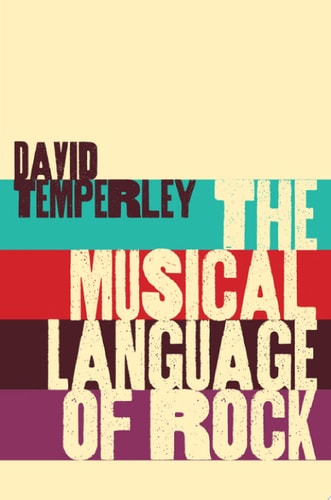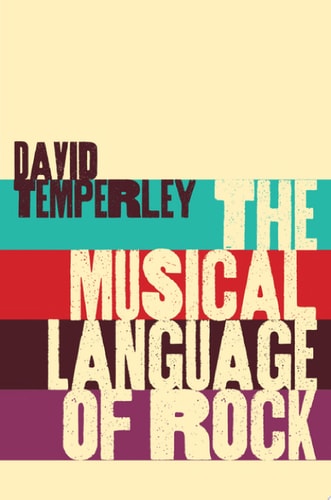
The Musical Language of Rock
0
0
As an Amazon Associate and affiliate partner, Menrva Books earns from qualifying purchases. Learn more
Author Description
In all of the books about rock music, relatively few focus on the purely musical dimensions of the style: dimensions of harmony and melody, tonality and scale, rhythm and meter, phrase structure and form, and emotional expression. The Musical Language of Rock puts forth a new, comprehensive theoretical framework for the study of rock music by addressing each of these aspects. Eastman music theorist and cognition researcher David Temperley brings together a conventional music-analytic approach with statistical corpus analysis to offer an innovative and insightful approach to the genre. With examples from across a broadly defined rock idiom encompassing everything from the Beatles to Deep Purple, Michael Jackson to Bonnie Raitt, The Musical Language of Rock shows how rock musicians exploit musical parameters to achieve aesthetic and expressive goals-for example, the manipulation of expectation and surprise, the communication of such oppositions as continuity/closure and tension/relaxation, and the expression of emotional states. A major innovation of the book is a three-dimensional model of musical expression-representing valence, energy, and tension-which proves to be a powerful tool for characterizing songs and also for tracing expressive shifts within them. The book includes many musical examples, with sound clips available on the book's website. The Musical Language of Rock presents new insights on the powerful musical mechanisms which have made rock a hallmark of our contemporary musical landscape.
Menrva's Summary
THE THESIS
This book investigates the core musical mechanisms—including harmony, melody, rhythm, and form—that define the aesthetic and expressive language of rock music. David Temperley, a music theorist and cognition researcher at the Eastman School of Music, constructs a comprehensive theoretical framework to analyze these elements. By synthesizing traditional music-analytic techniques with statistical corpus analysis, the author provides a structured methodology for understanding how rock musicians manipulate musical parameters to achieve specific expressive outcomes.
THE SCOPE MAP
What You Will Find
- A three-dimensional model of musical expression measuring valence, energy, and tension.
- Analysis of harmony, tonality, scale, rhythm, meter, and phrase structure.
- Comparative studies of artists ranging from the Beatles to Michael Jackson.
- Integration of statistical corpus analysis with qualitative music theory.
Scope Limits
- The text focuses primarily on the formal musical dimensions rather than the sociological or historical context of the genre.
- The analysis is restricted to the specific rock idiom defined by the author and does not cover all subgenres of popular music.
THE AUTHORITY PERSPECTIVE
Experts recognize this work as a significant contribution to the formal study of popular music, noting its rigorous application of music theory to a genre often analyzed only through cultural lenses. Readers frequently highlight the utility of the three-dimensional expression model for both academic research and practical song analysis.
Page Count:
310
Publication Date:
2018-01-01
Publisher:
Oxford University Press
ISBN-10:
0190653795
ISBN-13:
9780190653798
Rock music
Humanities
Musicology
Music theory
Academic
Exercises
Music Technology