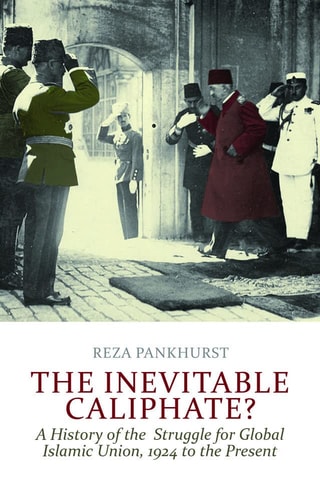
The Inevitable Caliphate? A History of the Struggle for Global Islamic Union, 1924 to Present
0
0
As an Amazon Associate and affiliate partner, Menrva Books earns from qualifying purchases. Learn more
Author Description
While in the West 'the Caliphate' evokes overwhelmingly negative images, throughout Islamic history it has been regarded as the ideal Islamic polity. In the wake of the 'Arab Spring' and the removal of long-standing dictators in the Middle East, in which the dominant discourse appears to be one of the compatibility of Islam and democracy, reviving the Caliphate has continued to exercise the minds of its opponents and advocates. Reza Pankhurst's book contributes to our understanding of Islam in politics, the path of Islamic revival across the last century and how the popularity of the Caliphate in Muslim discourse waned and later re-emerged. Beginning with the abolition of the Caliphate, the ideas and discourse of the Muslim Brotherhood, Hizb ut-Tahrir, al-Qaeda and other smaller groups are then examined. A comparative analysis highlights the core com- monalities as well as differences between the various movements and individuals, and suggests that as movements struggle to re-establish a polity which expresses the unity of the ummah (or global Islamic community), the Caliphate has alternatively been ignored, had its significance minimised or denied, reclaimed and promoted as a theory and symbol in different ways, yet still serves as a political ideal for many.
Menrva's Summary
THE THESIS
The abolition of the Ottoman Caliphate in 1924 sparked a century-long debate and struggle over the ideal Islamic polity. Reza Pankhurst's work examines the re-emergence and varying interpretations of the Caliphate in Muslim discourse, particularly in the wake of the Arab Spring. The book analyzes the ideas and discourse of key movements such as the Muslim Brotherhood, Hizb ut-Tahrir, and al-Qaeda, alongside other smaller groups. Through comparative analysis, it highlights the commonalities and differences in their approaches to re-establishing a unified global Islamic community, revealing how the Caliphate has been alternately ignored, minimized, denied, reclaimed, and promoted as a potent political ideal.
THE SCOPE MAP
- The historical context of the Caliphate and its abolition in 1924.
- Analysis of the discourse and ideas of the Muslim Brotherhood.
- Examination of Hizb ut-Tahrir's approach to Islamic revival.
- Investigation into the role of the Caliphate in the ideologies of groups like al-Qaeda.
- Comparative analysis of various movements and individuals advocating for or against the Caliphate.
- Discussion on the waning and re-emergence of the Caliphate's popularity in Muslim discourse.
- Exploration of the Caliphate as a political ideal for the global Islamic community (ummah).
THE AUTHORITY PERSPECTIVE
The book is an academic examination of a complex political and religious concept. It delves into the historical and contemporary significance of the Caliphate within Muslim communities, tracing its evolution from an ideal polity to a contested symbol. The analysis focuses on the intellectual and ideological currents driving movements that seek to revive or redefine the Caliphate. The work is likely to be of interest to scholars of Islamic studies, political science, and Middle Eastern history, offering a nuanced perspective on a topic often subject to simplistic interpretations.
Page Count:
280
Publication Date:
2013-01-01
Publisher:
Hurst
ISBN-10:
1849042519
ISBN-13:
9781849042512
Politics
Non-Fiction
Religion
History
Community Tags
Similar Books














