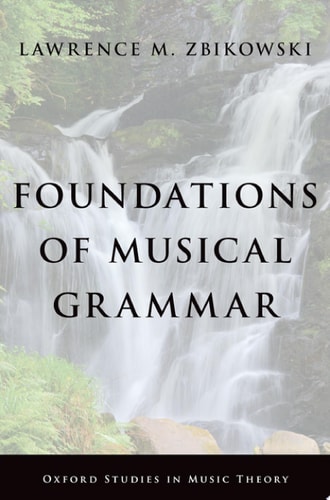
Foundations of Musical Grammar
0
0
As an Amazon Associate and affiliate partner, Menrva Books earns from qualifying purchases. Learn more
Author Description
In recent years, music theorists have been increasingly eager to incorporate findings from the science of human cognition and linguistics into their methodology. In the culmination of a vast body of research undertaken since his influential and award-winning Conceptualizing Music (OUP 2002), Lawrence M. Zbikowski puts forward Foundations of Musical Grammar, an ambitious and broadly encompassing account on the foundations of musical grammar based on our current understanding of human cognitive capacities. Musical grammar is conceived of as a species of construction grammar, in which grammatical elements are form-function pairs. Zbikowski proposes that the basic function of music is to provide sonic analogs for dynamic processes that are important in human cultural interactions. He focuses on three such processes: those concerned with the emotions, the spontaneous gestures that accompany speech, and the patterned movement of dance. Throughout the book, Zbikowski connects cognitive research with music theory for an interdisciplinary audience, presenting detailed musical analyses and summaries of the basic elements of musical grammar.
Menrva's Summary
THE THESIS
This book investigates the cognitive foundations of musical grammar by proposing that music functions as a system of sonic analogs for dynamic human cultural processes. Lawrence M. Zbikowski, a prominent scholar in music theory and cognitive science, builds upon his previous research to construct a framework where musical elements are understood as form-function pairs. By integrating linguistics and cognitive psychology, he argues that music mirrors the structures found in emotional expression, speech-accompanying gestures, and dance. The text provides a systematic account of how these cognitive capacities inform the creation and interpretation of musical structures.
THE SCOPE MAP
What You Will Find
- A construction grammar framework applied to musical analysis
- Theoretical exploration of emotions, speech gestures, and dance patterns as foundations for musical meaning
- Detailed musical analyses demonstrating the proposed grammatical elements
- Interdisciplinary synthesis of cognitive science and music theory
Scope Limits
- The text does not provide a comprehensive history of Western music theory
- It does not focus on performance practice or pedagogical instruction for musicians
THE AUTHORITY PERSPECTIVE
Scholars and music theorists recognize this work as a significant contribution to the intersection of cognitive science and musicology. Readers frequently note the academic density of the prose, which is intended for an audience familiar with both music theory and linguistic frameworks.
Page Count:
270
Publication Date:
2017-01-01
Publisher:
Oxford University Press
ISBN-10:
0190653655
ISBN-13:
9780190653651
Music Technology
Humanities
Linguistics
Music theory
Musicology
Academic
Music