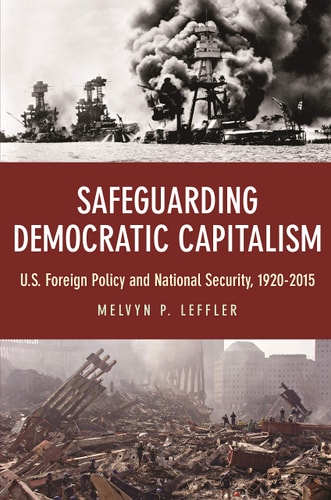
Safeguarding Democratic Capitalism: U.S. Foreign Policy and National Security, 1920-2015
0
0
As an Amazon Associate and affiliate partner, Menrva Books earns from qualifying purchases. Learn more
Author Description
Safeguarding Democratic Capitalism gathers together decades of writing by Melvyn Leffler, one of the most respected historians of American foreign policy, to address important questions about U.S. national security policy from the end of World War I to the global war on terror. Why did the United States withdraw strategically from Europe after World War I and not after World War II? How did World War II reshape Americans’ understanding of their vital interests? What caused the United States to achieve victory in the long Cold War? To what extent did 9/11 transform U.S. national security policy? Is budgetary austerity a fundamental threat to U.S. national interests? Leffler’s wide-ranging essays explain how foreign policy evolved into national security policy. He stresses the competing priorities that forced policymakers to make agonizing trade-offs and illuminates the travails of the policymaking process itself. While assessing the course of U.S. national security policy, he also interrogates the evolution of his own scholarship. Over time, slowly and almost unconsciously, Leffler’s work has married elements of revisionism with realism to form a unique synthesis that uses threat perception as a lens to understand how and why policymakers reconcile the pressures emanating from external dangers and internal priorities. An account of the development of U.S. national security policy by one of its most influential thinkers, Safeguarding Democratic Capitalism includes a substantial new introduction from the author.
Menrva's Summary
THE THESIS
This collection examines the evolution of U.S. national security policy from the aftermath of World War I through the global war on terror. Melvyn P. Leffler, a distinguished historian of American foreign policy, analyzes key questions regarding the nation's strategic choices and evolving interests. The essays explore the reasons behind post-WWI withdrawal versus post-WWII engagement, the impact of WWII on American perceptions of vital interests, the factors contributing to victory in the Cold War, and the transformative effects of 9/11 on security policy. Leffler also addresses the ongoing debate about budgetary austerity's threat to national interests, tracing how foreign policy became national security policy and highlighting the difficult trade-offs faced by policymakers.
THE SCOPE MAP
- Analysis of U.S. strategic decisions following World War I and World War II.
- Examination of how World War II reshaped American understanding of its global interests.
- Exploration of the factors leading to U.S. victory in the Cold War.
- Assessment of the impact of the September 11th attacks on U.S. national security strategy.
- Discussion on the role of budgetary austerity in relation to U.S. national interests.
- Explanation of the transition from foreign policy to national security policy.
- Illumination of the policymaking process and the inherent trade-offs involved.
- Interrogation of the evolution of Leffler's own scholarship, particularly his synthesis of revisionism and realism through the lens of threat perception.
THE AUTHORITY PERSPECTIVE
As a collection of writings by one of the most respected historians of American foreign policy, Safeguarding Democratic Capitalism is expected to offer a comprehensive and insightful analysis of U.S. national security policy over nearly a century. The book's structure, gathering decades of work, suggests a deep dive into the historical context and evolving challenges faced by policymakers. The inclusion of a substantial new introduction indicates a contemporary perspective on these historical trends. The author's established reputation implies a scholarly and authoritative treatment of complex geopolitical and economic issues.
Page Count:
360
Publication Date:
2019-10-22
Publisher:
Princeton University Press
ISBN-10:
0691196516
ISBN-13:
9780691196510
Non-Fiction
History
Economics
Politics
Community Tags
Similar Books