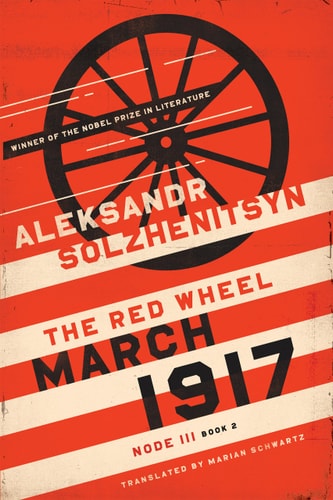
March 1917: The Red Wheel
0
0
As an Amazon Associate and affiliate partner, Menrva Books earns from qualifying purchases. Learn more
Author Description
Aleksandr Solzhenitsyn's March 1917, Book 2, covers three days of the February Revolution when the nation unraveled, leading to the Bolshevik takeover eight months later. The Red Wheel is Nobel Prize-winner Aleksandr Solzhenitsyn's multivolume epic work about the Russian Revolution. He spent decades writing about just four of the most important periods, or "nodes." This is the first time that the monumental March 1917--the third node--has been translated into English. It tells the story of the Russian Revolution itself, during which the Imperial government melts in the face of the mob, and the giants of the opposition also prove incapable of controlling the course of events. The action of Book 2 (of four) of March 1917 is set during March 13-15, 1917, the Russian Revolution's turbulent second week. The revolution has already won inside the capital, Petrograd. News of the revolution flashes across all Russia through the telegraph system of the Ministry of Roads and Railways. But this is wartime, and the real power is with the army. At Emperor Nikolai II's order, the Supreme Command sends troops to suppress the revolution in Petrograd. Meanwhile, victory speeches ring out at Petrograd's Tauride Palace. Inside, two parallel power structures emerge: the Provisional Government and the Executive Committee of the Petrograd Soviet of Workers' and Soldiers' Deputies, which sends out its famous "Order No. 1," presaging the destruction of the army. The troops sent to suppress the Petrograd revolution are halted by the army's own top commanders. The Emperor is detained and abdicates, and his ministers are jailed and sent to the Peter and Paul Fortress. This sweeping, historical novel is a must-read for Solzhenitsyn's many fans, as well as those interested in twentieth-century history, Russian history and literature, and military history.
Menrva's Summary
THE PULSE
The fabric of the Russian Empire begins to tear as the February Revolution erupts in Petrograd, threatening to unravel the nation and pave the way for future upheaval. The narrative follows the tumultuous events of March 13-15, 1917, focusing on the collapse of imperial authority and the inability of opposition leaders to control the unfolding chaos. As news of the revolution spreads, the army's loyalty is tested, and the Emperor's abdication sets the stage for a power struggle between the Provisional Government and the Petrograd Soviet, all within the context of a world war that complicates every decision.
INSIDE THE PAGES
- Detailed account of the three days of March 13-15, 1917, during the February Revolution.
- Exploration of the collapse of the Imperial government in Petrograd.
- Depiction of the emergence of parallel power structures: the Provisional Government and the Petrograd Soviet.
- Analysis of the significance of Petrograd Soviet's "Order No. 1" on the army's structure.
- Narrative of the army's intervention and subsequent halting by its own commanders.
- The detention and abdication of Emperor Nikolai II.
- The imprisonment of the Emperor's ministers in the Peter and Paul Fortress.
- Contextualization of these events within World War I.
THE COLLECTIVE ECHO
As the third node in Aleksandr Solzhenitsyn's monumental "The Red Wheel" epic, March 1917 is presented as a critical examination of the Russian Revolution's pivotal moments. The narrative's focus on the intricate political and military machinations during a period of profound national crisis suggests a work of deep historical and literary significance. The novel's detailed portrayal of the unraveling of imperial power and the subsequent power vacuum is likely to appeal to readers interested in 20th-century Russian history, literature, and the complexities of revolutionary periods. The work's scope and detailed reconstruction of events position it as a significant contribution to the historical novel genre.
Page Count:
703
Publication Date:
2019-01-01
Publisher:
University of Notre Dame Press
ISBN-10:
0268106851
ISBN-13:
9780268106850
History
Fiction
Historical Fiction
Literary Fiction
Community Tags
Similar Books














