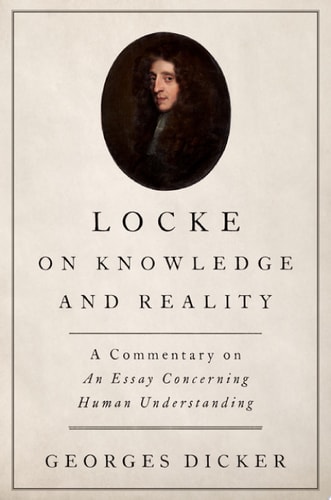
Locke on Knowledge and Reality
0
0
As an Amazon Associate and affiliate partner, Menrva Books earns from qualifying purchases. Learn more
Author Description
Georges Dicker Here Provides A Commentary On John Locke's Masterwork, An Essay Concerning Human Understanding-the Foundational Work Of Classical Empiricism. Dicker's Commentary Is An Accessible Guide For Students Who Are Reading Locke For The First Time; A Useful Research Tool For Upper-level Undergraduate And Graduate Students; And A Contribution To Locke Scholarship For Professional Scholars. It Is Designed To Be Read Alongside The Essay, But Does Not Presuppose Familiarity With It. Dicker Expounds And Critically Discusses The Main Theses And Arguments Of Each Of The Essay's Four Books, On The Innatism That Locke Opposes, The Origin And Classification Of Ideas, Language And Meaning, And Knowledge, Respectively. He Analyses Locke's Influential Explorations Of Related Topics, Including Primary And Secondary Qualities, Substance, Identity, Personal Identity, Free Will, Nominal And Real Essences, Perception, And External-world Skepticism, Among Others. Written In An Analytical Style That Strives For Clarity, The Book Offers Careful Textual Analyses As Well As Step-by-step Reconstructions Of Locke's Arguments, And It References And Engages With Relevant Work Of Other Major Philosophers And Locke Commentators.
Menrva's Summary
THE THESIS
This book investigates the core arguments and philosophical framework of John Locke's An Essay Concerning Human Understanding to clarify his contributions to classical empiricism. Georges Dicker, a scholar of modern philosophy, provides a systematic reconstruction of Locke's primary theses. The text utilizes a rigorous analytical approach to break down complex arguments regarding the origin of ideas, the nature of reality, and the limits of human knowledge.
THE SCOPE MAP
What You Will Find
- Detailed analysis of the four books of An Essay Concerning Human Understanding
- Reconstructions of arguments on innatism, language, and personal identity
- Examination of primary and secondary qualities, substance, and external-world skepticism
- Engagement with contemporary Locke scholarship and historical philosophical context
Scope Limits
- The text focuses primarily on Locke's epistemology and metaphysics rather than his political philosophy
- It does not provide a comprehensive biography of Locke's life outside of his intellectual output
THE AUTHORITY PERSPECTIVE
Experts and students alike recognize this work as a highly accessible and structured guide for navigating Locke's dense prose. The text is frequently cited as a reliable resource for both undergraduate students and professional scholars seeking a clear, step-by-step reconstruction of classical empiricist arguments.
Page Count:
288
Publication Date:
2019-01-01
Publisher:
Oxford University Press
ISBN-10:
0190662212
ISBN-13:
9780190662219
Philosophy
Academic
Philosophy history
Epistemology
Empiricism
Community Tags
Similar Books