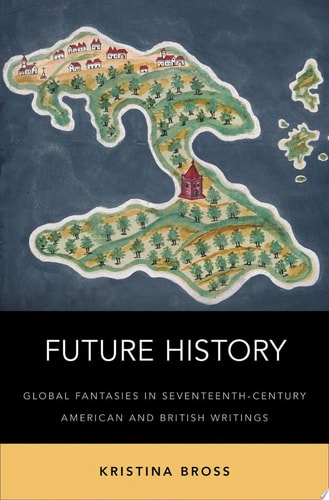
Future History: Global Fantasies in Seventeenth-Century American and British Writings
0
0
As an Amazon Associate and affiliate partner, Menrva Books earns from qualifying purchases. Learn more
Author Description
Future History traces the ways that English and American writers oriented themselves along an East-West axis to fantasize their place in the world. The book builds on new transoceanic scholarship and recent calls to approach early American studies from a global perspective. Such scholarship has largely focused on the early national period; Bross's work begins earlier and considers the intertwined identities of America, other English colonial sites and metropolitan England during a period before nation-state identities were hardened into the forms we know them today, when an English empire was nascent, not realized, and when a global perspective such as we might recognize it was just coming into focus for early modern Europeans. The author examines works that imagine England on a global stage in the Americas and East Indies just as--and in some cases even before--England occupied such spaces in force. Future History considers works written from the 1620s to the 1670s, but the center of gravity of Future History is writing at the mid-century, that is, writings coincident with the Interregnum, a time when England plotted and launched ambitious, often violent schemes to conquer, colonize or otherwise appropriate other lands, driven by both mercantile and religious desires.
Menrva's Summary
THE THESIS
This book investigates how seventeenth-century English and American writers utilized an East-West geopolitical axis to conceptualize their global identity during the nascent stages of the British Empire. Kristina Bross, a scholar of early American literature, synthesizes transoceanic scholarship to analyze how colonial and metropolitan texts imagined England's role in the Americas and the East Indies. By focusing on the mid-seventeenth century, specifically the Interregnum, she argues that these writings reflect a period of fluid national identity driven by mercantile ambition and religious fervor before the solidification of modern nation-states.
THE SCOPE MAP
What You Will Find
- Analysis of literary works produced between the 1620s and 1670s.
- Examination of the intersection between colonial expansion and early modern global consciousness.
- Investigation of the ideological motivations behind English colonial schemes.
Scope Limits
- The study does not focus on the early national period of the United States.
- The text does not provide a comprehensive military history of the Interregnum.
THE AUTHORITY PERSPECTIVE
Scholars recognize this work as a significant contribution to transoceanic studies that challenges traditional nationalistic frameworks in early modern literature. Experts frequently note that the text provides a nuanced look at how imperial fantasies preceded actual colonial occupation in the seventeenth century.
Page Count:
243
Publication Date:
2017-01-01
Publisher:
Oxford University Press
ISBN-10:
0190665157
ISBN-13:
9780190665159
History
English literature
Early Modern
British History
Colonialism
Literary Criticism
American History
American Studies
Community Tags
Similar Books