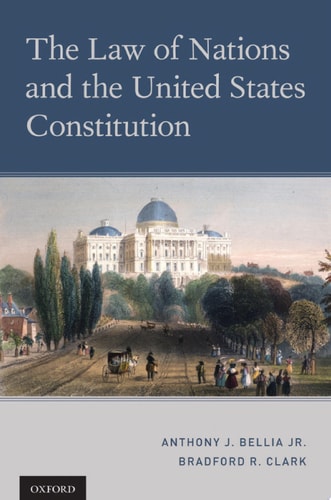
The Law of Nations and the United States Constitution
0
0
As an Amazon Associate and affiliate partner, Menrva Books earns from qualifying purchases. Learn more
Author Description
The Law of Nations and the United States Constitution offers a new lens through which anyone interested in constitutional governance in the United States should analyze the role and status of customary international law in U.S. courts. The book explains that the law of nations has not interacted with the Constitution in any single overarching way. Rather, the Constitution was designed to interact in distinct ways with each of the three traditional branches of the law of nations that existed when it was adopted--namely, the law merchant, the law of state-state relations, and the law maritime. By disaggregating how different parts of the Constitution interacted with different kinds of international law, the book provides an account of historical understandings and judicial precedent that will help judges and scholars more readily identify and resolve the constitutional questions presented by judicial use of customary international law today. Part I describes the three traditional branches of the law of nations and examines their relationship with the Constitution. Part II describes the emergence of modern customary international law in the twentieth century, considers how it differs from the traditional branches of the law of nations, and explains why its role or status in U.S. courts requires an independent, context-specific analysis of its interaction with the Constitution. Part III assesses how both modern and traditional customary international law should be understood to interact with the Constitution today.
Menrva's Summary
THE THESIS
This book investigates how the law of nations interacts with the United States Constitution by analyzing the historical and legal distinctions between various branches of international law. The authors, Anthony J. Bellia Jr. and Bradford R. Clark, utilize extensive historical research and judicial precedent to argue that the Constitution was designed to engage with specific categories of international law—the law merchant, the law of state-state relations, and the law maritime—in distinct ways. By disaggregating these traditional branches, the authors provide a framework for understanding how modern customary international law should be evaluated within the American constitutional system.
THE SCOPE MAP
What You Will Find
- A historical analysis of the three traditional branches of the law of nations.
- A comparative study of how the Constitution interacts with traditional versus modern international law.
- A methodology for resolving contemporary constitutional questions regarding judicial use of international law.
Scope Limits
- The text does not provide a comprehensive history of international relations outside of its specific constitutional application.
- It does not offer a political critique of international policy, focusing instead on legal and judicial mechanics.
THE AUTHORITY PERSPECTIVE
Legal scholars and practitioners frequently cite this work as a foundational text for understanding the intersection of domestic constitutional governance and international legal obligations. Experts highlight the authors' meticulous historical approach as a necessary tool for navigating the complexities of modern judicial interpretation.
Page Count:
320
Publication Date:
2017-01-01
Publisher:
Oxford University Press
ISBN-10:
0190666781
ISBN-13:
9780190666781
Constitutional Law
Constitutions
Professional Career & Trade
International Law
Law
Legal History
Community Tags
Other Editions(3)

Similar Books








Reader Comments
Share Your Thoughts
No comments yet. Be the first to share your thoughts!