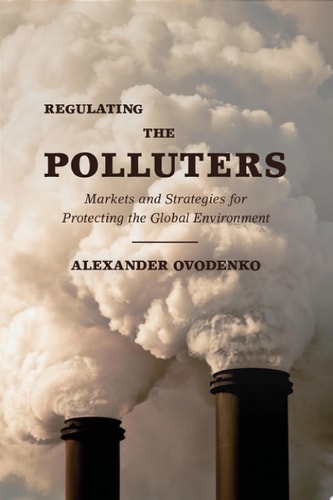
Regulating the Polluters: Markets and Strategies for Protecting the Global Environment
0
0
As an Amazon Associate and affiliate partner, Menrva Books earns from qualifying purchases. Learn more
Author Description
National governments and private stakeholders have long recognized that protecting the global environment requires international cooperation. Climate change, tropical deforestation, biodiversity loss, ozone depletion, hazardous wastes, and ocean pollution are among several issues that have brought national governments together in common purpose. As they have worked to mitigate these global problems, governments have developed a wide variety of environmental regime designs. Some global environmental regimes are more institutionally integrated than others. Some regimes impose legally binding obligations on countries while others involve non-binding commitments. And some regimes involve global standards and rules while others leave national commitments up to countries' discretion. What explains the pattern of regime design in global environmental governance?Alexander Ovodenko demonstrates that national governments have developed different institutional responses to global issues because the markets producing environmental pollution impose varying constraints and create varying opportunities for governments. Contrary to the prevailing literature, governments are more inclined to impose stringent rules and regulations on oligopolistic industries than on competitive ones. The capital resources and innovation potential of oligopolistic businesses make them more cost-effective and economical in reducing pollution and meeting global standards than businesses in competitive industries. In global governance, oligopolistic businesses face a "double-edged sword" arising from their wealth and market concentrations. Regulating the Polluters inverts the literature on regulatory capture and collective action by presenting empirical evidence of the irony of market power in global environmental politics.
Menrva's Summary
THE THESIS
What explains the variation in institutional design and stringency across global environmental regimes? Alexander Ovodenko, a scholar of international relations and environmental politics, argues that the structure of the market producing a specific pollutant dictates the regulatory response. By analyzing the relationship between industry concentration and policy stringency, the author posits that governments are more likely to impose rigorous, binding regulations on oligopolistic industries than on competitive ones due to the superior capital and innovation capacity of large firms.
THE SCOPE MAP
What You Will Find
- Comparative analysis of diverse environmental regimes including ozone depletion, hazardous waste, and climate change.
- A theoretical framework linking market structure to regulatory outcomes.
- Empirical evidence challenging traditional theories of regulatory capture.
Scope Limits
- The analysis focuses primarily on international regime design rather than domestic implementation success.
- The study does not extensively cover non-state actor influence outside of the corporate-government nexus.
THE AUTHORITY PERSPECTIVE
Experts recognize this work as a significant contribution to the study of international political economy and environmental governance. Scholars frequently note that the author provides a clear, data-driven challenge to conventional wisdom regarding corporate influence in global policy-making.
Page Count:
256
Publication Date:
2017-09-12
Publisher:
Oxford University Press
ISBN-10:
0190677724
ISBN-13:
9780190677725
Economics
Pollution
International relations
Public Policy
Community Tags
Similar Books