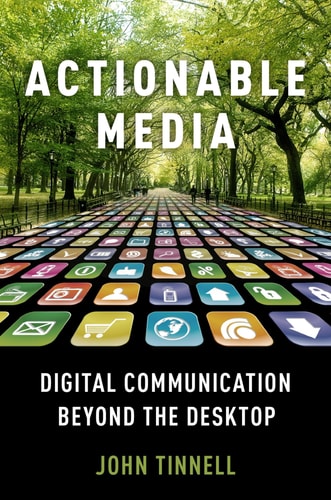
Actionable Media: Digital Communication Beyond the Desktop
0
0
As an Amazon Associate and affiliate partner, Menrva Books earns from qualifying purchases. Learn more
Author Description
In 1991, Mark Weiser and his team at Xerox PARC declared they were reinventing computers for the twenty-first century. The computer would become integrated into the fabric of everyday life; it would shift to the background rather than being itself an object of focus. The resulting rise of ubiquitous computing (smartphones, smartglasses, smart cities) have since thoroughly colonized our digital landscape. In Actionable Media, John Tinnell contends that there is an unsung rhetorical dimension to Weiser's legacy, which stretches far beyond recent iProducts. Taking up Weiser's motto, "Start from the arts and humanities," Tinnell develops a theoretical framework for understanding nascent initiatives--the Internet of things, wearable interfaces, augmented reality--in terms of their intellectual history, their relationship to earlier communication technologies, and their potential to become vibrant platforms for public culture and critical media production.It is clear that an ever-widening array of everyday spaces now double as venues for multimedia authorship. Writers, activists, and students, in cities and towns everywhere, are digitally augmenting physical environments. Audio walks embed narratives around local parks for pedestrians to encounter during a stroll; online forums are woven into urban infrastructure and suburban plazas to invigorate community politics. This new wave of digital communication, which Tinnell terms "actionable media," is presented through case studies of exemplar projects by leading artists, designers, and research-creation teams. Chapters alter notions of ubiquitous computing through concepts drawn from Bernard Stiegler, Gregory Ulmer, and Hannah Arendt; from comparative media analyses with writing systems such as cuneiform, urban signage, and GUI software; and from relevant stylistic insights gleaned from the open air arts practices of Augusto Boal, Claude Monet, and Janet Cardiff. Actionable Media challenges familiar claims about the combinat
Menrva's Summary
THE THESIS
How can the principles of ubiquitous computing be re-evaluated through the lens of the arts and humanities to foster public culture and critical media production? John Tinnell, a scholar in media studies, synthesizes intellectual history with contemporary technological developments to argue that digital communication has moved beyond the desktop into the physical environment. By drawing on the work of thinkers like Bernard Stiegler and Hannah Arendt, Tinnell establishes a framework for understanding how everyday spaces are being transformed into platforms for authorship and civic engagement.
THE SCOPE MAP
What You Will Find
- Theoretical analysis of ubiquitous computing, including the Internet of Things and augmented reality.
- Case studies of projects by artists, designers, and research-creation teams.
- Comparative media analysis linking modern digital interfaces to historical writing systems like cuneiform and urban signage.
Scope Limits
- The text does not provide a technical manual for software development or hardware engineering.
- It does not offer a comprehensive history of all computing devices, focusing instead on the rhetorical and cultural implications of specific interface types.
THE AUTHORITY PERSPECTIVE
Scholars and media theorists frequently cite this work for its interdisciplinary approach to digital communication and its application of humanities-based theory to modern technology. Readers often note the academic density of the prose, which is intended for an audience familiar with media studies and critical theory.
Page Count:
278
Publication Date:
2017-11-16
Publisher:
Oxford University Press
ISBN-10:
0190678089
ISBN-13:
9780190678081
Technology
Mass media
Sociology
Media Studies
Communication
Community Tags
Other Editions(2)
Similar Books

Reader Comments
Share Your Thoughts
No comments yet. Be the first to share your thoughts!