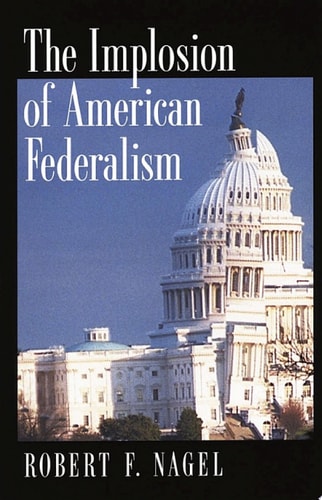
The Implosion of American Federalism
0
0
As an Amazon Associate and affiliate partner, Menrva Books earns from qualifying purchases. Learn more
Author Description
At a time of unprecedented national power, why do so many Americans believe that our nationhood is fragile and precarious? Why the talk--among politicians, academics, and jurists--of "coups d'etat," of culture wars, of confederation, of constitutional breakdown? In this wide-ranging book, Robert Nagel proposes a surprising answer: that anxiety about national unity is caused by centralization itself. Moreover, he proposes that this anxiety has dangerous cultural consequences that are, in an implosive cycle, pushing the country toward ever greater centralization. Carefully examining recent landmark Supreme Court cases that protect states' rights, Nagel argues that the federal judiciary is not leading and is not likely to lead a revival of the complex system called federalism. A robust version of federalism requires apprecation for political conflict and respect for disagreement about constitutional meaning, both values that are deeply antithetical to the Court's function. That so many believe this most centralized of our Nation's institutions is protecting, even overprotecting, state power is itself a sign of the depletion of those understandings necessary to sustain the federal system. Instead of a support for federalism, Nagel finds a commitment to radical nationalism throughout the constitutional law establishment. He traces this commitment to traditionally American traits like perfectionism, optimism, individualism, and legalism. Under modern conditions of centralization, these attractive traits are leading to unattractive social consequences, including tolerance, fearfulness, utopianism, and deceptiveness. They are degrading our political discourse. All this encourages further centralization and further cultural deterioration. This book puts the major federalism decisions within the framework of the Court's overall record, including its record on individual rights in areas like abortion, homosexuality, and school desegregation.
Menrva's Summary
THE THESIS
This book investigates why the expansion of national power and centralization in the United States has paradoxically fostered a sense of national fragility and cultural instability. Robert F. Nagel, a professor of law, utilizes a critical analysis of Supreme Court jurisprudence to argue that the judiciary is fundamentally incapable of reviving federalism. He posits that the American legal establishment is committed to a form of radical nationalism that is incompatible with the political conflict and constitutional disagreement necessary for a robust federal system.
THE SCOPE MAP
What You Will Find
- Analysis of landmark Supreme Court cases regarding states' rights and federal authority.
- Examination of the intersection between American cultural traits like perfectionism and individualism and modern political centralization.
- A critique of the federal judiciary's role in shaping national identity and constitutional interpretation.
Scope Limits
- The book does not provide a comprehensive history of American federalism from the founding era.
- It does not offer a prescriptive policy manual for reversing centralization, focusing instead on the diagnostic analysis of current trends.
THE AUTHORITY PERSPECTIVE
Legal scholars and political scientists frequently cite this work for its provocative challenge to the conventional understanding of the Supreme Court's role in protecting state power. Readers often note the dense, analytical nature of the prose, which demands a high level of familiarity with constitutional law and political theory.
Page Count:
218
Publication Date:
2002-01-01
Publisher:
Oxford University Press
ISBN-10:
0190289201
ISBN-13:
9780190289201
American Government
Legal Theory
Constitutional Law
Professional Career & Trade
Federalism
Community Tags
Other Editions(4)


Similar Books




Reader Comments
Share Your Thoughts
No comments yet. Be the first to share your thoughts!