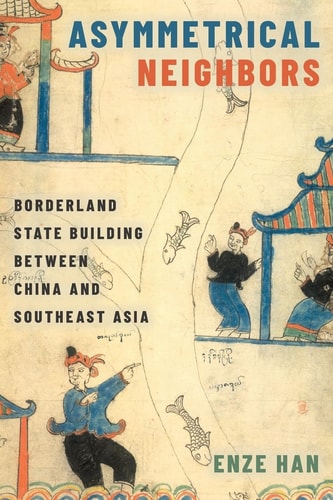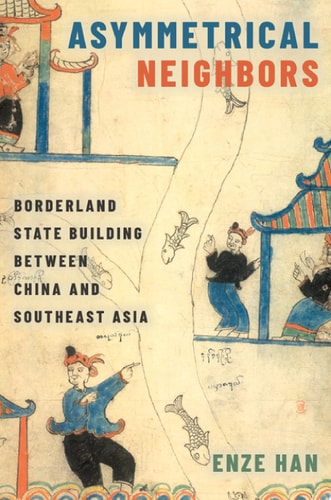
Asymmetrical Neighbors: Borderland State Building between China and Southeast Asia
0
0
As an Amazon Associate and affiliate partner, Menrva Books earns from qualifying purchases. Learn more
Author Description
Is the process of state building a unilateral, national venture, or is it something more collaborative, taking place in the interstices between adjoining countries? To answer this question, Asymmetrical Neighbors takes a comparative look at the state building process along China, Myanmar, and Thailand's common borderland area. It shows that the variations in state building among these neighboring countries are the result of an interactive process that occurs across national boundaries. Departing from existing approaches that look at such processes from the angle of singular, bounded territorial states, the book argues that a more fruitful method is to examine how state and nation building in one country can influence, and be influenced by, the same processes across borders. It argues that the success or failure of one country's state building is a process that extends beyond domestic factors such as war preparation, political institutions, and geographic and demographic variables. Rather, it shows that we should conceptualize state building as an interactive process heavily influenced by a "neighborhood effect." Furthermore, the book moves beyond the academic boundaries that divide arbitrarily China studies and Southeast Asian studies by providing an analysis that ties the state and nation building processes in China with those of Southeast Asia.
Menrva's Summary
THE THESIS
This book investigates whether state building is a strictly internal national endeavor or an interactive process shaped by the dynamics between neighboring countries. Author Enze Han, a scholar specializing in ethnic politics and international relations in Asia, utilizes comparative historical analysis to challenge the traditional view of the state as a bounded, autonomous entity. He argues that the success or failure of state building is significantly influenced by a "neighborhood effect," where political and social developments in one country directly impact the institutional trajectory of its neighbors.
THE SCOPE MAP
What You Will Find
- Comparative analysis of state building processes in China, Myanmar, and Thailand.
- A theoretical framework centered on the "neighborhood effect" in borderland regions.
- Examination of how cross-border interactions influence domestic political institutions and national identity.
Scope Limits
- The analysis is geographically restricted to the specific borderland regions shared by China, Myanmar, and Thailand.
- The study does not provide a comprehensive history of all Southeast Asian state formation, focusing instead on the interactive aspects of the selected border areas.
THE AUTHORITY PERSPECTIVE
Scholars in the field of international relations and Asian studies frequently cite this work for its ability to bridge the academic divide between China studies and Southeast Asian studies. Experts note that the text provides a rigorous, data-driven challenge to conventional Westphalian models of state formation by highlighting the importance of transnational influences.
Page Count:
254
Publication Date:
2019-01-01
Publisher:
Oxford University Press
ISBN-10:
0190688327
ISBN-13:
9780190688325
International relations
Border Studies
Asian Studies
Comparative Politics
Geopolitics
State Building