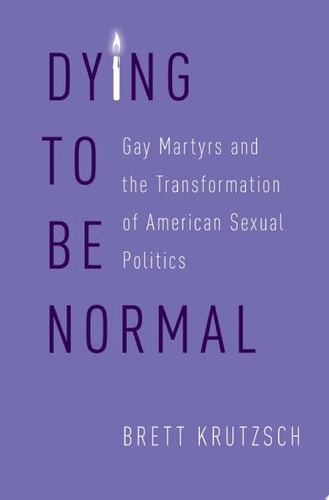
Dying to Be Normal: Gay Martyrs and the Transformation of American Sexual Politics
0
0
As an Amazon Associate and affiliate partner, Menrva Books earns from qualifying purchases. Learn more
Author Description
Finalist, Best LGBTQ Nonfiction Book, Lambda Literary Awards 2020 On October 14, 1998, five thousand people gathered on the steps of the U.S. Capitol to mourn the death of Matthew Shepard, a gay college student who had been murdered in Wyoming eight days earlier. Politicians and celebrities addressed the crowd and the televised national audience to share their grief with the country. Never before had a gay citizen's murder elicited such widespread outrage or concern from straight Americans. In Dying to Be Normal, Brett Krutzsch argues that gay activists memorialized people like Shepard as part of a political strategy to present gays as similar to the country's dominant class of white, straight Christians. Through an examination of publicly mourned gay deaths, Krutzsch counters the common perception that LGBT politics and religion have been oppositional and reveals how gay activists used religion to bolster the argument that gays are essentially the same as straights, and therefore deserving of equal rights. Krutzsch's analysis turns to the memorialization of Shepard, Harvey Milk, Tyler Clementi, Brandon Teena, and F. C. Martinez, to campaigns like the It Gets Better Project, and national tragedies like the Pulse nightclub shooting to illustrate how activists used prominent deaths to win acceptance, influence political debates over LGBT rights, and encourage assimilation. Throughout, Krutzsch shows how, in the fight for greater social inclusion, activists relied on Christian values and rhetoric to portray gays as upstanding Americans. As Krutzsch demonstrates, gay activists regularly reinforced a white Protestant vision of acceptable American citizenship that often excluded people of color, gender-variant individuals, non-Christians, and those who did not adhere to Protestant Christianity's sexual standards. The first book to detail how martyrdom has influenced national debates over LGBT rights, Dying to Be Normal establishes how religion has shaped gay assimilation
Menrva's Summary
THE THESIS
How have gay activists utilized the public memorialization of murder victims to influence American political discourse and advocate for social inclusion? Brett Krutzsch, a scholar in religious and gender studies, examines the intersection of LGBT rights movements and Christian rhetoric. He argues that activists strategically framed gay victims as martyrs to align with white, Protestant American values, thereby promoting an assimilationist agenda that often marginalized non-conforming individuals.
THE SCOPE MAP
What You Will Find
- Analysis of high-profile cases including Matthew Shepard, Harvey Milk, Tyler Clementi, Brandon Teena, and F. C. Martinez.
- Examination of the It Gets Better Project and the response to the Pulse nightclub shooting.
- Investigation into the use of Christian moral frameworks to define acceptable citizenship.
Scope Limits
- The text focuses primarily on American political and social contexts rather than international LGBTQ movements.
- The analysis centers on the intersection of religion and politics, leaving aside broader economic or purely legalistic critiques of the movement.
THE AUTHORITY PERSPECTIVE
Scholars and critics recognize this work as a significant contribution to the study of queer politics and the role of religious rhetoric in social movements. Readers frequently note the academic density of the prose and the provocative nature of the author's critique regarding assimilationist strategies.
Page Count:
263
Publication Date:
2019-01-01
Publisher:
Oxford University Press
ISBN-10:
0190685239
ISBN-13:
9780190685232
Religion
History
Special Topics
LGBTQ Studies
Religious Aspects
Sociology
Sex
American History
Gays
Community Tags
Similar Books