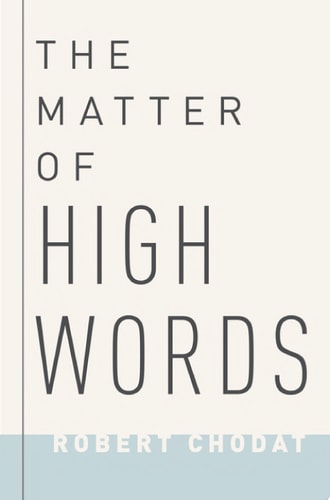
The Matter of High Words: Naturalism, Normativity, and the Postwar Sage
0
0
As an Amazon Associate and affiliate partner, Menrva Books earns from qualifying purchases. Learn more
Author Description
In a world of matter, how can we express what matters? When the explanations of the natural sciences become powerfully precise and authoritative, what is the status of our highest words, the languages that articulate our norms and orient our lives? The Matter of High Words examines a constellation of American writers who in the decades since World War II have posed these questions in distinctive ways. Walker Percy, Marilynne Robinson, Ralph Ellison, Stanley Cavell, and David Foster Wallace are all self-consciously post-WWII authors, attuned to the fragmentation and skepticism that have defined so much of the literary and critical culture of the last century and more. Yet they also attempt to reach back to older forms of thought and writing that are often thought to have dried up-the traditions of prophecy, of wisdom literature, of the sage. Working within this dual inheritance, these authors are drawn equally to both art and argument, “showing” and “telling,” shifting continually between narrative and discursive genres. In their essays they act as moralists, promoting the broad, abstract concepts that might inspire action in the face of naturalistic reduction: community, family, courage, fraternity, marriage, friendship, temperance, judgment. In their narratives, they offer particular lives in particular settings, thick descriptions that give flesh to such high words. Rarely do these movements between genres generate a tidy equilibrium; where their essays speak of cooperation and redemption, their narratives display alienation, loss, and failure. But in pursuing such risky, unorthodox strategies, these postwar sages are not only able to challenge some of the dominant naturalistic theories of the last several decades: cognitive science, neo-Darwinian theory, social science, the fact-value divide in analytic philosophy. Through five chapters of detailed analysis and close reading, Chodat explores the question of whether vocabularies of ought and ought-not can still em
Menrva's Summary
THE THESIS
This book investigates how postwar American writers reconcile the authoritative, reductive explanations of natural science with the persistent human need for normative, moral language. Robert Chodat, a scholar of literature and philosophy, examines how authors like Walker Percy and Marilynne Robinson navigate the tension between scientific naturalism and the traditional role of the sage. He argues that these writers utilize a hybrid approach, blending narrative fiction with discursive essays to reassert the relevance of moral concepts in a secular, scientific age.
THE SCOPE MAP
What You Will Find
- Analysis of the intersection between cognitive science, neo-Darwinian theory, and literary expression.
- Examination of the 'sage' archetype within the context of 20th-century American literature.
- Comparative study of narrative 'showing' versus discursive 'telling' in moral philosophy.
Scope Limits
- The analysis is restricted to five specific American authors and does not provide a comprehensive survey of all postwar literature.
- The text focuses primarily on the philosophical implications of these works rather than their broader historical or political contexts.
THE AUTHORITY PERSPECTIVE
Scholars and critics recognize this work as a rigorous contribution to the study of literature and philosophy, noting its dense, academic prose. It is frequently cited as a significant resource for those interested in the intellectual history of the postwar era and the ongoing debate between naturalism and humanistic inquiry.
Page Count:
360
Publication Date:
2017-01-01
Publisher:
Oxford University Press
ISBN-10:
0190682175
ISBN-13:
9780190682170
Philosophy
American
Literary Criticism
In literature
Community Tags
Similar Books