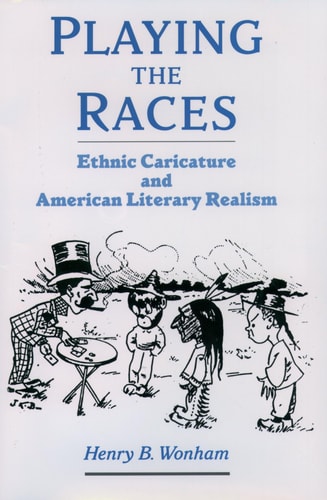
Playing the Races: Ethnic Caricature and American Literary Realism
0
0
As an Amazon Associate and affiliate partner, Menrva Books earns from qualifying purchases. Learn more
Author Description
Why did so many of the writers who aligned themselves with the social and aesthetic aims of American literary realism rely on stock conventions of ethnic caricature in their treatment of immigrant and African-American figures? As a self-described "tool of the democratic spirit," designed to "prick the bubble of abstract types," literary realism would seem to have little in common with the aggressively dehumanizing comic imagery that began to proliferate in magazines and newspapers after the Civil War. Indeed, critics such as Alain Locke hailed realism's potential to accomplish "the artistic emancipation of the Negro," a project that logically extended to other groups systematically misrepresented in the comic imagery of the period. From the influential "Editor's Study" at Harper's Monthly, William Dean Howells touted the democratic impulse of realist imagery as an alternative to romanticism's "pride of caste," which is "averse to the mass of men" and "consents to know them only in some conventionalized and artificial guise."Yet if literary realism pursued the interests of democracy by affirming "the equality of things and the unity of men," why did its major practitioners, including Howells himself, regularly employ comic typification as a feature of their representational practice? Critics have often dismissed such apparent lapses in realist practice as blind spots, vestiges of a genteel social consciousness that failed to keep pace with realism's avowed democratic aspirations. Such explanations are useful to a point, but they overlook the fact that the age of realism in American art and letters was simultaneously the great age of ethnic caricature. Henry B. Wonham argues that these two aesthetic programs, one committed to representation of the fully humanized individual, the other invested in broad ethnic abstractions, operate less as antithetical choices than as complementary impulses, both of which receive full play within the period's most demanding literary an
Menrva's Summary
THE THESIS
This book investigates the paradoxical reliance of American literary realists on ethnic caricature despite their stated commitment to democratic representation and the rejection of artificial types. Henry B. Wonham, a scholar of American literature, examines the tension between the realist movement's goal of humanizing the individual and the pervasive use of dehumanizing comic imagery in post-Civil War American culture. By analyzing the works of major figures like William Dean Howells, the author argues that these two seemingly contradictory aesthetic programs functioned as complementary impulses within the period's literary framework.
THE SCOPE MAP
What You Will Find
- Analysis of post-Civil War American literary realism and its aesthetic goals.
- Examination of the proliferation of ethnic caricature in magazines and newspapers of the era.
- Case studies of major realist writers and their representational practices regarding immigrant and African-American figures.
- Theoretical framework exploring the intersection of democratic ideals and comic typification.
THE AUTHORITY PERSPECTIVE
Scholars recognize this work as a significant contribution to the study of American literary history and the complexities of realist aesthetics. Readers frequently note the academic density of the prose and the author's ability to challenge traditional interpretations of the realist movement.
Page Count:
208
Publication Date:
2004-06-17
Publisher:
Oxford University Press
ISBN-10:
0195161947
ISBN-13:
9780195161946
History
English
English & College Success
Sociology
United States
American
In literature
Caricatures and cartoons
Literary Criticism
Community Tags
Other Editions(2)

Similar Books




Reader Comments
Share Your Thoughts
No comments yet. Be the first to share your thoughts!