Paris and the Cliché of History
0
0
As an Amazon Associate and affiliate partner, Menrva Books earns from qualifying purchases. Learn more
Author Description
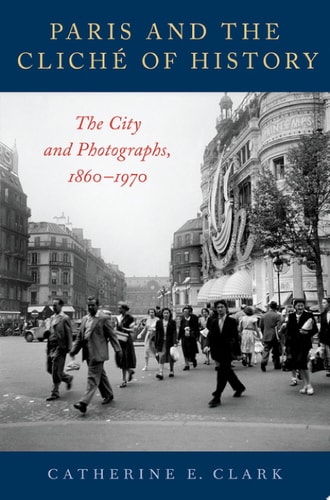
This book turns a compelling new lens on thinking about the history of Paris and photography. The invention of photography changed how history could be written. But the now commonplace assumptions--that photographs capture fragments of lost time or present emotional gateways to the past--that structure today's understandings did not emerge whole cloth in 1839. Focusing on one of photography's birthplaces, Paris and the Cliché of History tells the story of how photographs came to be imagined as documents of the past. Author Catherine E. Clark analyzes photography's effects on historical interpretation by examining the formation of Paris's first photo archives at the Musée Carnavalet and the city's municipal library, their use in illustrated history books and historical exhibitions and reconstructions such as the 1951 celebration of Paris's 2000th birthday, and the public's contribution to the historical record in amateur photo contests. Despite the photograph's growing importance in these forums, it did not simply replace older forms of illustration, visual documentation, or written text. Photos worked in complex and shifting relation to other types of pictures as photographers, popular historians, and publishers built on the traditions and iconography of painting and engraving in order to both document the past scientifically and objectively and to reconstruct it romantically. In doing so, they not only influenced how Parisians thought about the city's past and how they pictured it; they also ensured that these images shaped how Parisians lived their own lives--especially in deeply charged moments such as the Liberation after World War II. This history of picturing Paris does not simply reflect the city's history: it is Parisian history.
Menrva's Summary
THE THESIS
This book investigates how photography transformed the historical interpretation of Paris by examining the evolution of visual documentation from the nineteenth century through the post-World War II era. Catherine E. Clark, a historian of modern France, utilizes archival research from the Musée Carnavalet and the city's municipal library to challenge the assumption that photographs were immediately accepted as objective historical evidence. She argues that the status of the photograph as a historical document was constructed through a complex interplay of amateur contributions, institutional archiving, and the adaptation of existing artistic traditions like painting and engraving.
THE SCOPE MAP
What You Will Find
- Analysis of the formation of Paris's first municipal photo archives.
- Examination of photography's role in historical exhibitions and city celebrations, such as the 1951 bimillennial.
- Investigation into the influence of amateur photo contests on the public historical record.
- Study of the intersection between scientific documentation and romanticized historical reconstruction.
Scope Limits
- The analysis is geographically restricted to the city of Paris.
- The text focuses primarily on the evolution of historical perception rather than the technical history of camera equipment.
THE AUTHORITY PERSPECTIVE
Scholars and historians frequently cite this work for its rigorous archival approach to visual culture and its nuanced understanding of how media shapes collective memory. Readers often note the academic density of the prose, which serves as a foundational text for those studying the intersection of urban history and visual media.
Page Count:
272
Publication Date:
2018-01-01
Publisher:
Oxford University Press
ISBN-10:
0190681659
ISBN-13:
9780190681654
History
Photography
Urban Studies
European History
Art History
Community Tags
Similar Books