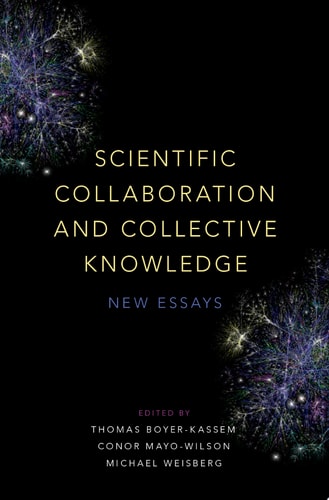
Scientific Collaboration and Collective Knowledge: New Essays
0
0
As an Amazon Associate and affiliate partner, Menrva Books earns from qualifying purchases. Learn more
Author Description
Descartes once argued that, with sufficient effort and skill, a single scientist could uncover fundamental truths about our world. Contemporary science proves the limits of this claim. From synthesizing the human genome to predicting the effects of climate change, some current scientific research requires the collaboration of hundreds (if not thousands) of scientists with various specializations. Additionally, the majority of published scientific research is now co-authored, including more than 80% of articles in the natural sciences, meaning small collaborative teams have become the norm in science.This volume is the first to address critical philosophical questions regarding how collective scientific research could be organized differently and how it should be organized. For example, should scientists be required to share knowledge with competing research teams? How can universities and grant-giving institutions promote successful collaborations? When hundreds of researchers contribute to a discovery, how should credit be assigned - and can minorities expect a fair share? When collaborative work contains significant errors or fraudulent data, who deserves blame?In this collection of essays, leading philosophers of science address these critical questions, among others. Their work extends current philosophical research on the social structure of science and contributes to the growing, interdisciplinary field of social epistemology. The volume's strength lies in the diversity of its authors' methodologies. Employing detailed case studies of scientific practice, mathematical models of scientific communities, and rigorous conceptual analysis, contributors to this volume study scientific groups of all kinds, including small labs, peer-review boards, and large international collaborations like those in climate science and particle physics.
Menrva's Summary
THE THESIS
This volume investigates how the shift from individual research to large-scale collaborative scientific efforts necessitates a new philosophical framework for understanding knowledge production. The editors, Conor Mayo-Wilson, Michael Weisberg, and Thomas Boyer-Kassem, curate a collection of essays from leading philosophers of science to address the structural, ethical, and epistemological challenges inherent in modern scientific practice. By examining the social organization of research, the authors argue that the traditional model of the solitary scientist is insufficient for addressing contemporary issues like credit assignment, institutional incentives, and accountability in massive collaborative projects.
THE SCOPE MAP
What You Will Find
- Philosophical analysis of social epistemology in scientific communities
- Mathematical models of research collaboration and knowledge sharing
- Case studies ranging from small laboratory teams to international particle physics collaborations
- Ethical frameworks for credit distribution and accountability in co-authored research
Scope Limits
- The text does not provide a practical handbook for managing specific laboratory personnel or administrative workflows
- It does not focus on the technical scientific discoveries themselves, but rather the social processes behind them
THE AUTHORITY PERSPECTIVE
Experts identify this collection as a foundational text for those studying the social structure of science and the philosophy of collaborative research. Readers frequently note the academic density of the prose, which is tailored for scholars and students within the fields of philosophy and science studies.
Page Count:
234
Publication Date:
2017-01-01
Publisher:
Oxford University Press
ISBN-10:
0190680555
ISBN-13:
9780190680558
Philosophy
Earth Sciences
Philosophy of
Academic
Sociology of Science
International Cooperation
Community Tags
Similar Books