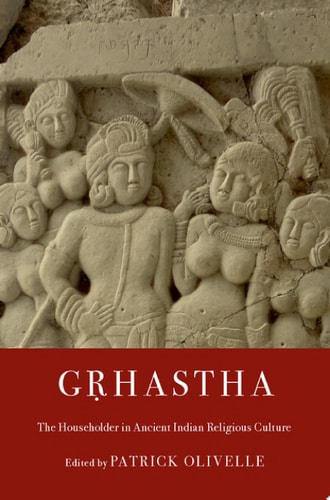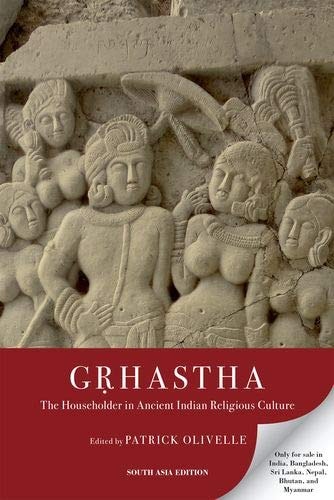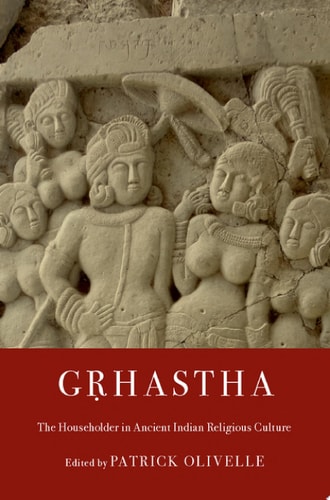
Grhastha: The Householder in Ancient Indian Religious Culture
0
0
As an Amazon Associate and affiliate partner, Menrva Books earns from qualifying purchases. Learn more
Author Description
For scholars of ancient Indian religions, the wandering mendicants who left home and family for a celibate life and the search for liberation represent an enigma. The Vedic religion, centered on the married household, had no place for such a figure. Much has been written about the Indian ascetic but hardly any scholarly attention has been paid to the married householder with wife and children, generally referred to in Sanskrit as gṛhastha: "the stay-at-home." The institution of the householder is viewed implicitly as posing little historical problems with regard to its origin or meaning.This volume problematizes the figure of the householder within ancient Indian culture and religion. It shows that the term gṛhastha is a neologism and is understandable only in its opposition to the ascetic who goes away from home (pravrajita). Through a thorough and comprehensive analysis of a wide range of inscriptions and texts, ranging from the Vedas, Dharmasastras, Epics, and belle lettres to Buddhist and Jain texts and texts on governance and erotics, this volume analyses the meanings, functions, and roles of the householder from the earliest times unti about the fifth century CE. The central finding of these studies is that the householder bearing the name gṛhastha is not simply a married man with a family but someone dedicated to the same or similar goals as an ascetic while remaining at home and performing the economic and ritual duties incumbent on him. The gṛhastha is thus not a generic householder, for whom there are many other Sanskrit terms, but a religiously charged concept that is intended as a full-fledged and even superior alternative to the concept of a religious renouncer.
Menrva's Summary
THE THESIS
This volume investigates the historical and conceptual origins of the gṛhastha, or householder, as a religiously significant figure in ancient Indian culture. Patrick Olivelle, a scholar of Indian religions, challenges the assumption that the householder was a static or self-evident social role. By analyzing a vast array of primary sources, he argues that the term gṛhastha emerged as a specific, religiously charged identity defined in direct opposition to the ascetic renouncer.
THE SCOPE MAP
What You Will Find
- Analysis of Vedic, Dharmasastra, Epic, Buddhist, and Jain texts.
- Examination of inscriptions and literature concerning governance and erotics.
- A historical timeline spanning from early Vedic times to the fifth century CE.
Scope Limits
- The study does not extend beyond the fifth century CE.
- It focuses primarily on the specific religious construction of the gṛhastha rather than general domestic life.
THE AUTHORITY PERSPECTIVE
Scholars recognize this work as a rigorous re-evaluation of the domestic sphere in ancient Indian religious life. The text is noted for its dense, academic prose and its comprehensive synthesis of diverse textual traditions.
Page Count:
288
Publication Date:
2019-08-08
Publisher:
Oxford University Press
ISBN-10:
019069615X
ISBN-13:
9780190696153
History
Religion
Sociology of Religion
Hinduism
Vedas
Family
Ancient India