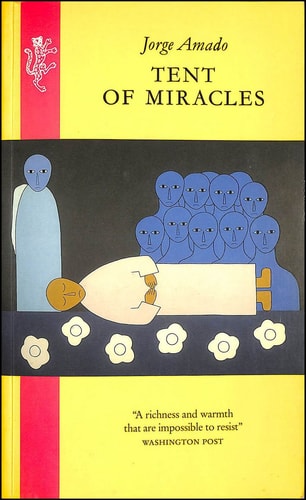
Tent of Miracles
0
0
As an Amazon Associate and affiliate partner, Menrva Books earns from qualifying purchases. Learn more
Author Description
The novel moves back and forth between events in the life of the historical hero, Pedro Archanjo, and the present. Most of the characters are types that lend themselves to the author's relentless satire. The historical setting is the colorful old Pelourinho neighborhood of Salvador, Bahia, that flows down the hill from the main plaza, where Archanjo works as a lowly runner at the School of Medicine adjacent to the cathedral. The place of the title is the home of the hero and his best friend, Lidio Corro, which also serves as barber shop, cultural center, print shop and artist's studio. The historical sections explore Afro-Brazilian culture and racial discrimination.
Menrva's Summary
THE PULSE
The narrative centers on the life and legacy of Pedro Archanjo, a self-taught intellectual whose radical ideas on racial mixing and Afro-Brazilian culture challenge the rigid social hierarchies of Salvador, Bahia. Archanjo, a humble runner at the School of Medicine, navigates a world defined by academic elitism and systemic prejudice while operating his 'Tent of Miracles'—a vibrant hub of art, printing, and cultural exchange. The story employs a non-linear structure, oscillating between historical accounts of Archanjo’s life and the modern-day efforts of those attempting to preserve or distort his memory. The protagonist must contend with institutional racism and the intellectual arrogance of the elite, who seek to suppress his contributions to the understanding of Brazilian identity.
INSIDE THE PAGES
- Non-linear narrative structure shifting between past and present
- Satirical character archetypes representing various social strata
- Vivid depiction of the Pelourinho neighborhood in Salvador
- Exploration of Afro-Brazilian religious and cultural traditions
- Critique of academic and institutional racism
- Integration of print shop culture as a medium for social change
- Focus on the tension between historical truth and myth-making
- Multi-perspective storytelling that highlights the diversity of Bahian society
THE COLLECTIVE ECHO
This work is widely regarded as a significant contribution to Latin American literature, noted for its vibrant portrayal of Bahian culture and its sharp, satirical edge. Readers and critics often highlight the author's ability to balance serious social critique with a celebratory, rhythmic prose style that captures the spirit of Salvador. The novel is frequently praised for its complex examination of racial identity and the way history is constructed by those in power. It remains a central text for those interested in the intersection of folklore, academic discourse, and the struggle for social justice in Brazil.
Page Count:
392
Publication Date:
1989-01-01
Publisher:
Collins Harvill
ISBN-10:
0002710226
ISBN-13:
9780002710220
Literary Fiction
Historical Fiction
Satire
Contemporary
Literature & Fiction
Social Commentary