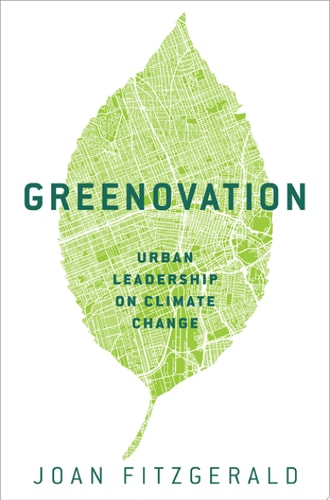
Greenovation: Urban Leadership on Climate Change
0
0
As an Amazon Associate and affiliate partner, Menrva Books earns from qualifying purchases. Learn more
Author Description
Collectively, cities take up a relatively tiny amount of land on the earth, yet emit 72 percent of greenhouse gas emissions. Clearly, cities need to be at the center of any broad effort to reduce climate change.In Greenovation, the eminent urban policy scholar Joan Fitzgerald argues that too many cities are only implementing random acts of greenness that will do little to address the climate crisis. She instead calls for "greenovation"--using the city as a test bed for adopting and perfecting green technologies for more energy--efficient buildings, transportation, and infrastructure more broadly. Further, Fitzgerald contends that while many city mayors cite income inequality as a pressing problem, few cities are connecting climate action and social justice-another aspect of greenovation. Focusing on the biggest producers of greenhouse gases in cities, buildings, energy and transportation, Fitzgerald examines how greenovating cities are reducing emissions overall and lays out an agenda for fostering and implementing urban innovations that can help reverse the path toward irrevocable climate damage. Drawing on interviews with practitioners in more than 20 North American and European cities, she identifies the strategies and policies they are employing and how support from state, provincial and national governments has supported or thwarted their efforts.A uniquely urban-focused appraisal of the economic, political, and social debates that underpin the drive to "go green," Greenovation helps us understand what is arguably the toughest policy problem of our era: the increasing impact of anthropocentric climate change on modern social life.
Menrva's Summary
THE THESIS
The core question investigated is how cities can move beyond superficial environmental initiatives to implement systemic, integrated strategies that address both climate change and social inequality. Joan Fitzgerald, an established urban policy scholar, utilizes a comparative analysis of over 20 North American and European cities to argue for "greenovation." This framework posits that cities must function as laboratories for energy-efficient infrastructure, building technology, and transportation systems while simultaneously prioritizing social justice outcomes.
THE SCOPE MAP
What You Will Find
- Analysis of greenhouse gas emission sources in urban environments, specifically buildings, energy, and transportation.
- A framework for integrating climate action with economic and social equity policies.
- Evaluation of the role of state, provincial, and national government support in local climate efforts.
Scope Limits
- The text does not provide a comprehensive technical manual for specific green engineering technologies.
- It does not cover rural or non-urban climate mitigation strategies.
THE AUTHORITY PERSPECTIVE
Experts recognize this work as a significant contribution to urban policy literature, particularly for its focus on the intersection of climate action and social equity. Readers frequently note the practical utility of the case studies for policymakers and urban planners seeking to move beyond incremental environmental changes.
Page Count:
256
Publication Date:
2020-03-27
Publisher:
Oxford University Press
ISBN-10:
019069551X
ISBN-13:
9780190695514
urban planning
Rural
Government Policy
Local government
Public Policy
Climatic changes
Sustainability
City Planning
Climate Change
Community Tags
Similar Books