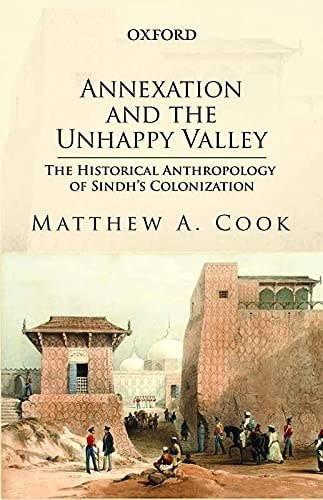
Annexation and the Unhappy Valley: The Historical Anthropology of Sindh’s Colonization
0
0
As an Amazon Associate and affiliate partner, Menrva Books earns from qualifying purchases. Learn more
Author Description
Annexation and the Unhappy The Historical Anthropology of Sindh’s Colonization addresses the nineteenth century expansion and consolidation of British colonial power in the Sindh region of South Asia. It adopts an interdisciplinary approach and employs a fine-grained, nuanced and situated reading of multiple agents and their actions. It explores how the political and administrative incorporation of territory (i.e., annexation) by East India Company informs the conversion of intra-cultural distinctions into socio-historical conflicts among the colonized and colonizers. The book focuses on colonial direct rule, rather than the more commonly studied indirect rule, of South Asia. It socio-culturally explores how agents, perspectives and intentions vary—both within and across regions—to impact the actions and structures of colonial governance.
Menrva's Summary
THE THESIS
This work investigates how the nineteenth-century annexation of the Sindh region by the East India Company transformed local cultural distinctions into enduring socio-historical conflicts. Matthew A. Cook, a professor specializing in South Asian and postcolonial studies, utilizes an interdisciplinary framework to analyze the mechanics of colonial direct rule. By examining the interplay between various agents, the text argues that colonial governance was not a monolithic process but a complex, situated interaction that fundamentally altered the social fabric of the region.
THE SCOPE MAP
What You Will Find
- Analysis of British colonial direct rule in nineteenth-century Sindh.
- Examination of how administrative incorporation influenced local social structures.
- Comparative study of diverse colonial and indigenous agents.
Scope Limits
- The text focuses specifically on direct rule rather than the indirect rule models common in other parts of South Asia.
- The analysis is geographically constrained to the Sindh region.
THE AUTHORITY PERSPECTIVE
Scholars in the field of South Asian history recognize this text as a significant contribution to the study of colonial administrative practices. Experts frequently highlight the author's ability to synthesize anthropological theory with historical archival research to provide a nuanced view of colonial power dynamics.
Page Count:
312
Publication Date:
2021-01-01
Publisher:
Oxford Pakistan
ISBN-10:
0190704322
ISBN-13:
9780190704322
History
Colonialism
Sociology
Anthropology
Subjects
Asian Studies
Community Tags
Similar Books